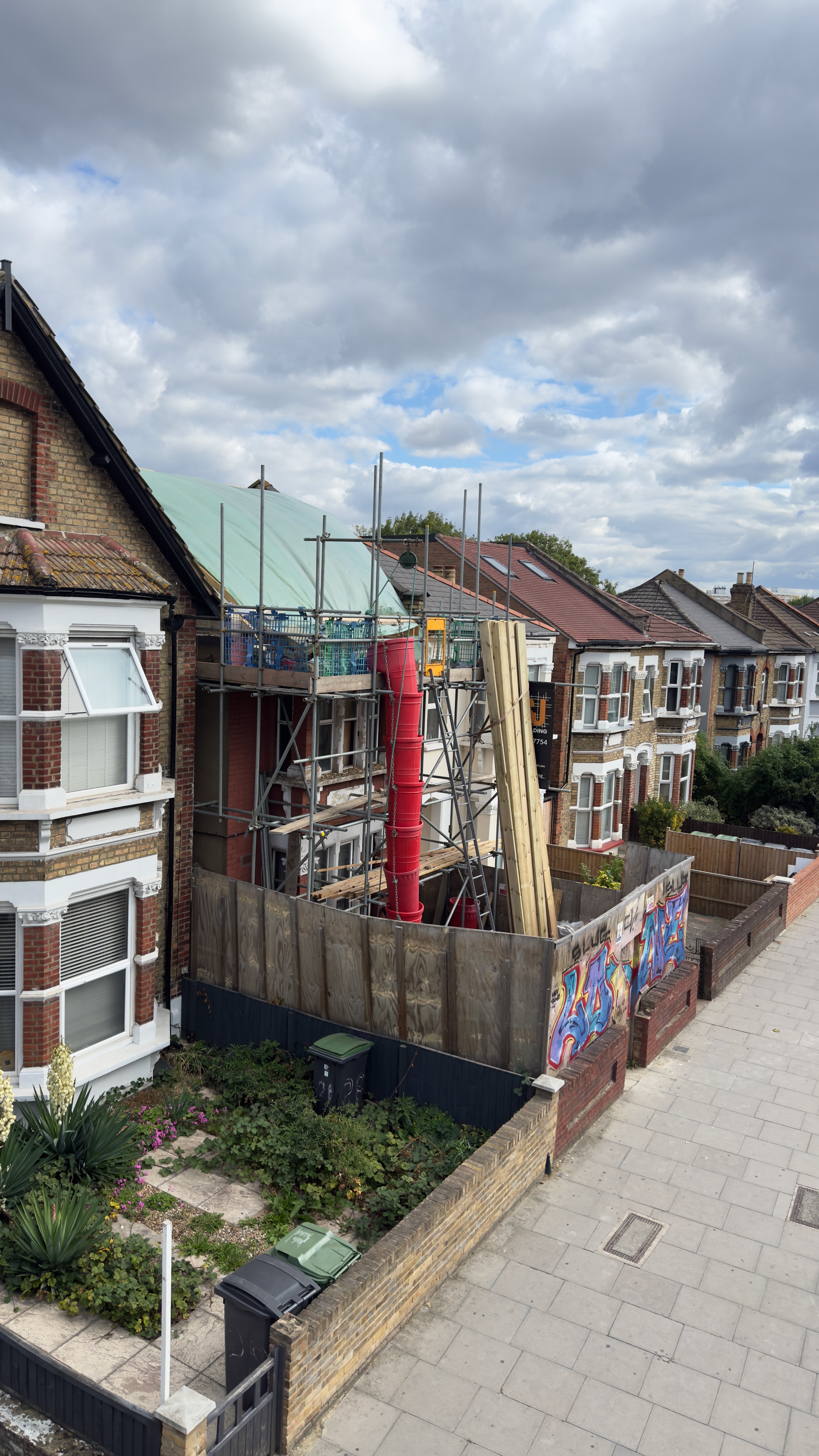
Photo: A house under renovation, Harringey, London, UK September 2025. Photo by the author.
Dear beautiful Interoperable readers, full disclosure: I’m on a bit of an upswing; things might get weird in a hopefully fun, manic way.
(In truth, I wrote that opening line six—maybe seven—weeks ago; I was, in fact, not on an upswing.
But it feels wrong to delete it and mope. Feelings are weird. To paraphrase a wise man: If it's mentionable, it's manageable. I think one of the smartest things I've ever done is register tylerdickey.com and start growing my own little space to share things that are important to me. Heck, naming the blog 'Interoperable' has taken on a new meaning of its own. At first, I thought it just meant raw mechanical or technical interoperability. In a big way, it has become a means to reflect on how to mesh into the world (and hammers and stuff, still, of course).
Anywho, it's Tyler Dickey here, I'm that weird uncle that completely understands your obsession with Jellycats. And this is INTEROPERABLE, my infrequent and mismanaged blog/newsletter thing about feelings, heavy yellow iron, and remembering to take your medication. By exposing what feels like a soft underbelly, I've gotten lovely feedback from my handful of readers, and that's meant the world to me.
Thank you for tuning in.
On to the show...
Thank you for tuning in.
On to the show...
“What’s a design-related hill you’re willing to die on?”
This excerpt from a recent special anniversary episode of 99% Invisible has been living rent-free in my head the last couple of weeks. In the episode, series producer Vivian Le interviews 99% Invisible creator Roman Mars:
VIVIAN LE: So, the next question is, “What’s a design-related hill you’re willing to die on?”
ROMAN MARS: I don’t want to die on any hill, I don’t think. I mean, mostly when it comes to certain design things or design movements, truly the answer is nothing. I can be convinced by a good story or a good reason for any ugly thing to exist or whatever, if it’s really thoughtful and done right. That was the whole premise of the show. If they couldn’t see the ugly building–because we were doing this on the radio or in podcasting–they could learn to love it before they learned to hate it by seeing it. You know what I mean? But the one that’s sticking with me–and this is gonna be kind of abstract, and I don’t know if this is going to come off well–is the idea of the march to make things more and more efficient makes the world a worse place. And I think of that in terms of advertising. The idea that we were going to efficiently measure how effective advertising was through clicks and eyeballs and stuff erased all of the extra money that made all the journalism and all the pop culture that you cared about in the 20th century–it made it all possible. The inefficiency of the advertising system made everything good in this world. I think that the idea that you’re trying to get things to be as efficient as possible is actually a terrible world-destroying idea. The most efficient restaurant is a ghost kitchen that has no storefront because that’s inefficient because it could be empty sometimes. And it’s a ghost’s kitchen that just ships you a thing and has an underpaid delivery person and brings it to your door and you never leave. And this is stripping away all the goodness of the world in those cities. I think efficiency is absolute garbage, and that is the design-related hill I’m willing to die on. I feel like you should always be allowing for great deals of inefficiency to make a nice designed city–a nice designed system–and make it work. I really hate the focus on efficiency. Not only does it destroy all these good things, it takes money and gives it to the worst people–the platform creators and the tech people–instead of all the loose, empty change and tips and things. And it’s not like things are cheaper or things are better. Money is being transferred to the wrong people instead of creators and people who make the world a better place through community and creation.
(I like to imagine that Roman dropped his mic after this) And you should take this as your call to do something inefficient today: take a big, deep breath of crisp autumnal air, make a soup with a pint of heavy cream in it, pet a dog, call your mum/mom.
Shades
I know that summer has waned, as has the time for a good pair of sunny Gs. I say don't be sad because Avery Trufelman and Alie Ward of Articles of Interest and Ologies, respectively, have both dropped episodes about Sunglasses/Optical Technology!
They both cover a lot of the same territory, but the intersections of fashion, health, and technology where they intersect is fascinating. Listening to a topic covered by two different hosts whom I admire was delightful. If you are not familiar with either Articles of Interest or Ologies, I highly recommend both. And if your listening backlog has staled, I have a whole page dedicated to Podcast Recommendations on my website.
Some Cool Things
- Mereidith Stern of Meredith Stern Interiors, currently has my favourite design Instagram account. She has an ongoing series of posts that start with "I Have This Thing With..." and then she curates a lovely little slideshow of interior design and architecture, from anything from glass block to door handles to terracotta. If you're in a sad cycle of Pinterest greige, barndominium, shiplap hell, give Meridith's Insta a browse for a curated design shot in the veins.
- How Greg Girard Creates his Landscape Photographs Willem Verbeek (YouTube) hosts an interview featuring Canadian photographer Greg Girard, who discusses his process of photographing Japan, China, and Canada from the 1970s to the present day.
- Open House Festival (London) I've been trying to attend at least one Open House Festival event per year since moving to London in 2018. I find a tour of a workshop, historic building, or sacred space to be incredibly eye-opening. I recommend booking a tour or checking the schedule next time you're in London in the Autumn, or checking locally to you what interesting open houses there might be near you!
- ACF 50 (Anti Corrosion Formula 50) - "a state-of-the-art, anti-corrosion lubricant compound, specifically designed for the Aerospace Industry. It is an ultra-thin fluid Film Compound (TFFC) that actively treats metal using advanced polar bonding technology." (Basically if you own something metal, and don't want it to corrode, give this Canadian wonder juice a go!)
- Why most scissors suck (and how we fixed it) Craighill (YouTube) - The wunderkind design team over at Craighill go into detail about the design behind their amazing-looking Chroma Scissors.
Thank you for tuning into the seventeenth edition of Interoperable. Whatever the hell this is that's happening right now, we'll get through it and we'll get through it together.
✷✷✷✷✷✷✷✷✷✷✷✷✷✷✷✷✷
Once again I'm still Tyler Dickey, and this is my newsletter, INTEROPERABLE. Here, I celebrate my never-ending love for reliable, available, and maintainable systems like RSS and telephony. I write about topics that interest me: art, reading, making things, and technology. Please consider subscribing or following me elsewhere on the internet: website | instagram
This publication will
- always be free of charge.
- always be informative and educational in nature.
- always credit and link to sources to the best of the author's ability.
- never be auto-generated or contain AI (LLM) generated content, aka slop¹.
- never contain any form of advertisements or undisclosed affiliate links.
¹Slop describes AI-generated content that is both unrequested and unreviewed. (Source)
Works Cited :
Roman Mars and Vivian Le. "The 99PI Anniversary Special: 15 for 15." 99% Invisible. Audio podcast, September 2, 2025.