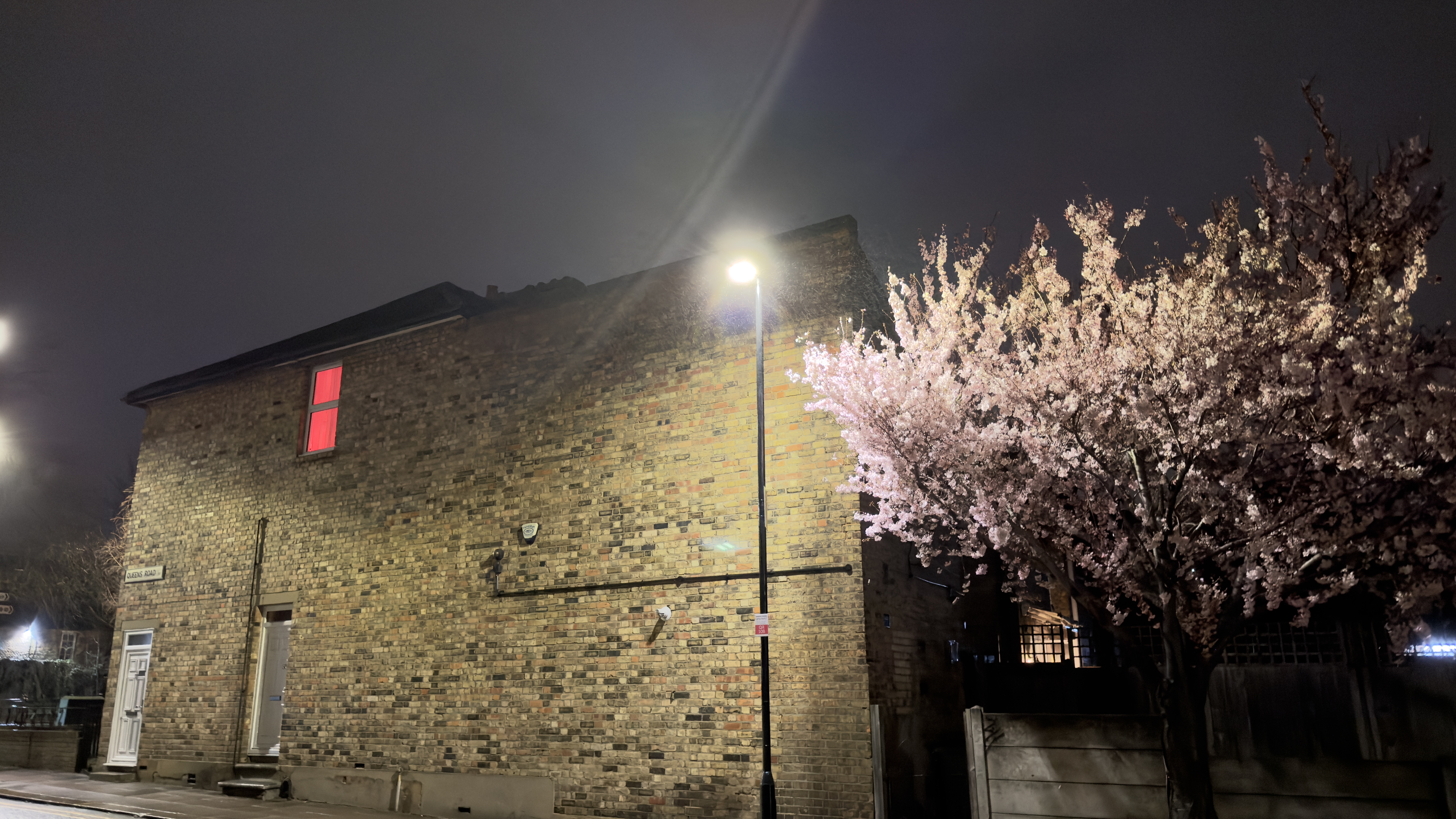
Figure 1. A spooky window and a tree in full spring bloom, Bounds Green, London, March 2026. Photograph by the author.
Hello again, sweet, beautiful INTEROPERABLE readers!
All of the tree blossoms seem to have exploded seemingly overnight, and the days have inched ever longer. The clocks are set to British Summer Time. Rejoice!
Like the sunshine in London, Tom Scott is back. His return project: visit every county in England—all 48 of them. I’m very much looking forward to Tom’s return and learning more about my adopted home. Episode one is out, where Tom visits The John Taylor Bell Foundry in Leicestershire (YouTube).
If you can’t wait for the rest of Tom’s 48-county romp, you can watch Harry Dwyer sail 1700 Miles in a Tiny Speedboat to circumnavigate the UK. This has been my favourite video travelogues in years, Harry and his rotating cast of companions complete a journey that is as breathtakingly vast yet doesn’t skip the small places with a unique, warm and sympathetic eye.
Both projects are, at their core, the same project: doing something large by accepting a small constraint. To me, my ultimate “small constraint” is literally living in a small space. With skyrocketing rents and house prices, you know the deal: “doing more with less” is a requirement and not merely an aesthetic or lifestyle choice for many. I still think we are getting over a collective Tiny house/Vanlife/Overlanding hangover—my 6’4” frame simply does not see the romance of living in a dubiously constructed quasi-legal dwelling, or for all intents and purposes: living in the car that I don’t own. That lifestyle may work for other people, but a non-negotiable for me is that I don’t want to smack my head when accessing 99% of my daily living space.
With “Overlanding” being the outlier, a hobby mostly centred around acquiring thousands of dollars' worth of gear to drive a very expensive “rig” to places a stock Toyota Rav4 can reach. Tiny houses and vanlife value fast and cheap solutions, quick conversions of existing vehicles, building practices to bypass building regulations, etc. They often entirely bypass the “Good” portion of the ubiquitous triple constraints of the project management: fast, good, cheap—pick two.
Life is too damn short to live cheap and fast. Which brings me to two core tenets I’ve been mulling over and implementing:
- First, we must build to last.
The things we build or bring into our lives must be made to endure. Vitruvius put his three principles in order for a reason: firmitas, utilitas, venustas (strength, utility, beauty). Clay Chapman is probably the most honest practitioner of “endurance” building today, with his aim to build “1000-year houses.” On smaller scales, looking for second-hand solid furniture or learning to repair items you already own (I always think the Recycle mantra of Reduce, Reuse, Recycle is missing a fourth R: Repair), there might even be a local repair group you can bring your worn-out or broken items to to have looked at. Now, if you go the DIY route, you might spend $50 repairing a pair of jeans you can replace for $25, but you’ve also spent $50 teaching yourself a new skill and acquiring the materials to complete the repair. That is to say: participate in a world of piecemeal growth—the idea that competence and quality accumulate through repeated small acts of making and repair rather than wholesale replacement.
- Think like you’re on a sailboat.
Noted fascist bastard and architect Le Corbusier referenced the ocean liner, he suggested that if architects designed houses like engineers design the functional parts of a ship, they would create a new architecture. Not only is this bad architecture, but it’s also bad urbanism. Le Corbusier envisioned a world of sprawling long “superblocks” that are ignorant of mixed uses and the economics of old buildings, and the “ballet of the sidewalk” as Jane Jacobs would describe it, among many other things.
I look to a smaller, less dominant vessel for inspiration: the humble sailboat. Now, don’t get me wrong, sailboats are largely toys for the wealthy. But in terms of design, they’re gorgeous, especially their thoughtful interiors. An example I saw recently was a man in a tiny New York studio apartment who used Magma cookware—designed for galley kitchens on sailing yachts, where a pan that doesn’t stack, nest, or pull double duty doesn’t come aboard. I’m not saying go out and spend thousands on expensive sailing wares to make your ramen noodles, but be more considerate of what takes up space and how best to utilise it. This could be a pull-out drawer under your sink, so you don’t have to dig for the sponges, or take the time to learn how to put up simple shelves to add some utility to a wasted corner of your kitchen.
My most wanted feature in my dream kitchen is an astiankuivauskaappi, which is Finnish for a dish drying cabinet. Essentially, it’s a cabinet with an open bottom and racks that’s placed above your sink so dishes can dry and be stored there. Niin siistiä! (So cool!) Nordic design at its finest.
For further research:
NEVER TOO SMALL (YouTube)
Jacobs, Jane. The Death and Life of Great American Cities. New York: Random House, 1961.
Ruskin, John. The Seven Lamps of Architecture. 1849. Reprint, New York: Dover Publications, 1990.
⁂
NEVER TOO SMALL (YouTube)
Jacobs, Jane. The Death and Life of Great American Cities. New York: Random House, 1961.
Ruskin, John. The Seven Lamps of Architecture. 1849. Reprint, New York: Dover Publications, 1990.
⁂
Shifting gears back to YouTube impresarios: Chris Spargo has done an in-depth look into the audio induction loop (YouTube, Wikipedia), an assistive technology for people with hearing loss. You’ve probably seen the blue symbol with the ear, a diagonal line and a T underneath. I won’t spoil Spargo’s adventure, but he does showcase the induction loop’s proposed successor, Auracast, which is based on the Bluetooth standard. This technology will hopefully soon allow anyone with a smartphone and a pair of Bluetooth headphones the ability to tune into Auracast transmissions. This would not only be a boon for people with hearing loss but also enable tons of interesting experiences for everyone. Another great example of assistive technologies ultimately benefiting us all.
Lastly, and just for fun, I was linked to this scientifically accurate black hole simulator —warning: unless you have a very powerful computer and/or phone, this may slow or crash your device. Source code and details. It’s loads of fun to play around with!
The recent Artemis II launch and ongoing updates from the mission (YouTube, NASA) have filled me with a strange feeling I have sadly not been feeling often: hope. It is just lovely to watch smart people working together on a project of such an immense scale, the knowledge from which will benefit humanity for generations to come. I hope you find something that makes you feel the same. Take care out there.
✷
✷ ✷
✷ ✷ ✷
✷ ✷ ✷ ✷
✷ ✷ ✷ ✷
✷ ✷ ✷
✷ ✷
✷
✷ ✷
✷ ✷ ✷
✷ ✷ ✷ ✷
✷ ✷ ✷ ✷
✷ ✷ ✷
✷ ✷
✷
Here, I celebrate my never-ending love for reliable, available, and maintainable systems like RSS and telephony. I write about topics that interest me: art, reading, making things, and technology.
All of the links: tylerdickey.mmm.page
This publication will
- always be free of charge
- always be informative and educational in nature
- always credit and link to sources to the best of the author’s ability
- never be auto-generated or contain AI (LLM)-generated content, aka slop¹
- never contain any form of advertisements or undisclosed affiliate links