Hey :)
I was working with a client recently and we spent an entire day just thinking.
I was working with a client recently and we spent an entire day just thinking.
And I really do mean that.
Our laptops were open for maybe fifteen minutes in total. The rest of the day was a whiteboard, pens, a bit of pacing around the room. Eight hours. Break for lunch. That was it.
At the end of the day, the client said something that stuck with me in a slightly uneasy, doubting-yourself way.
“Why doesn’t anyone else do this?”
What he was really asking, I think, was: is this actually necessary? Are we overthinking this? If other companies are successful, are they thinking like this… or are they just getting on with it?
And I recognised the feeling immediately, because I’ve felt it myself plenty of times.
I think a lot of that doubt comes from how much we undervalue thinking.
We massively overvalue outputs. Things you can point at. Things you can show. Tangible evidence that “work happened”. Slides, documents, emails sent, tasks completed. It’s visible. It’s legible. Other people can see it.
The truth is, nobody in the world knows what we did that day. No deliverable. No obvious proof.
Maybe a year or two from now the business looks completely different and you can draw a line back to that day. But in the moment? It just looks like two people in a room with a whiteboard.
There’s that old image that floats around from time to time of the thinker and the doer. The thinker is sitting there, thinking. The doer isn’t in the picture because they’re off doing things.
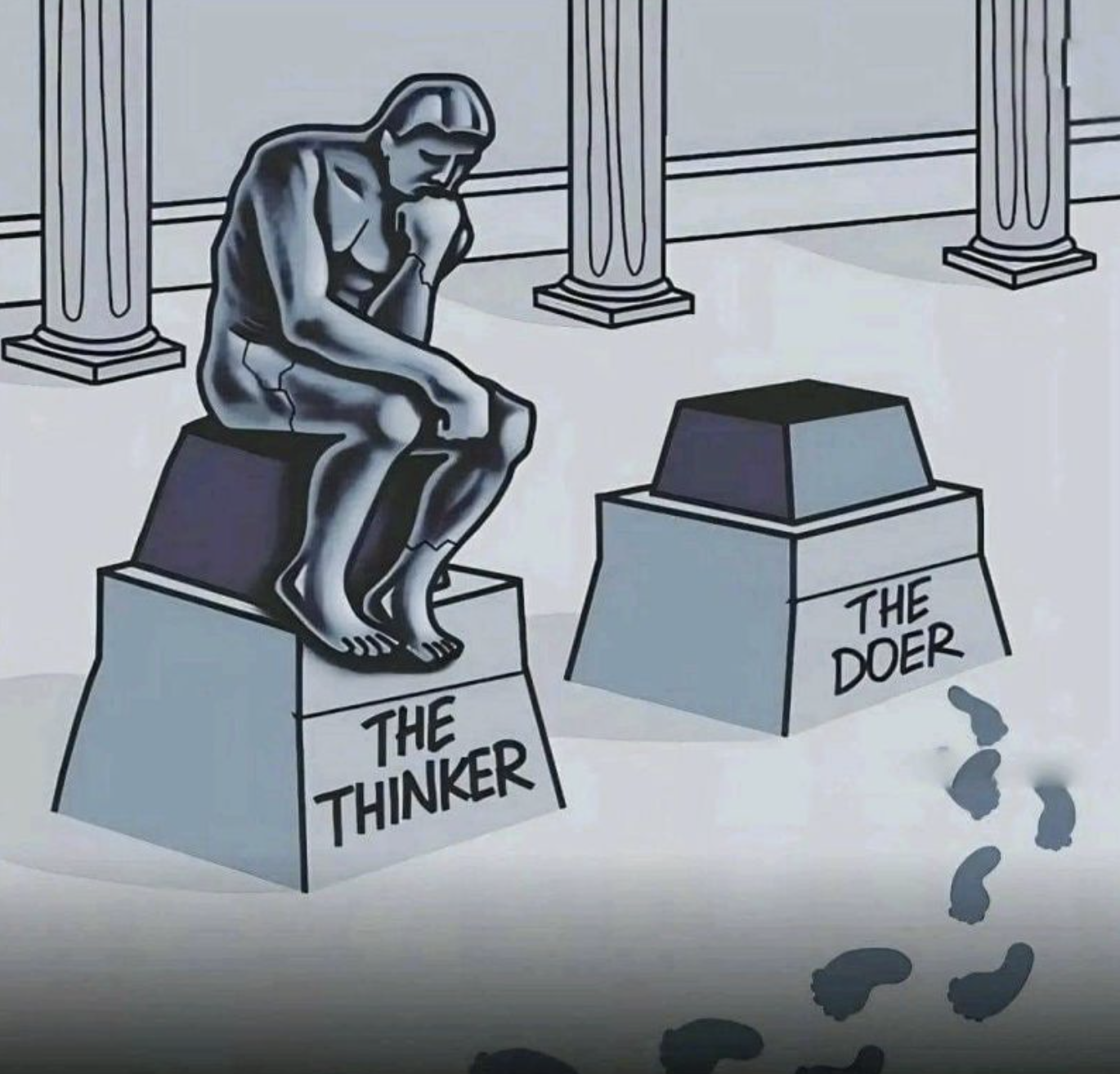
And culturally, we tend to admire the doer. The busy one. The one who’s always “on it”.
The older I get, and hopefully the wiser I get, the more I realise that most of the value I create now is the product of thought (ideas). I still work hard. I still put time and effort in. But there’s far more intention behind it than there used to be.
Being busy is actually very easy. You don’t need to choose anything. You just do the next thing.
Thinking is harder.
Thinking means choosing. It means debating trade-offs. It means sitting with uncertainty. And if you’re working with partners or multiple stakeholders, it means disagreement, tension, and conversations that don’t always resolve neatly.
You can avoid all of that tension by just taking action.
I also think ambition plays a big role here.
This client has a genuinely big ambition. A proper step-change goal. The kind that can’t be met by doing a bit more of what you already do.
A lot of businesses don’t need that level of rethinking. If you’re aiming for five or ten percent growth year on year, the path is fairly linear. More clients. More people. Push a bit harder. No real need to question the fundamentals.
But when the ambition is to build something that scales beyond you, something that doesn’t rely on you being in the middle of everything, the old ways stop working.
That’s where we kept bumping into this tension: the past and the present trying to dictate the future.
What we actually needed was the opposite. We needed the future to dictate what we do today.
And that’s uncomfortable. Because it exposes just how much of what you’re doing is based on habit, history, and assumptions that no longer serve where you’re trying to go.
I found myself really wanting to help him appreciate the value of his thinking. His ideas. Because at a certain point, that is the value you bring as an entrepreneur.
Your ability to see things differently. To imagine something that doesn’t exist yet. To make sense of complexity. And then to bring people with you.
Action matters, obviously. Ideas without execution go nowhere.
But I think we’ve swung too far in the other direction. We’ve made thinking feel indulgent. Risky. Hard to justify.
So we doubt ourselves when we do it.
Sometimes the most uncomfortable thing you can do isn’t pushing harder. It’s sitting still long enough to really think before you act.
🗣️ 👀
Chris.