Engineering Had Governance First. Then Marketing Demanded It Too.
Once I had the engineering side of the Dark Factory model working, governed pull requests, agentic workflows with clear handoffs, playbooks applied on every PR, a different problem became obvious. Engineering was touching marketing surfaces. And marketing had no equivalent governance layer.
That is not a complaint about marketing. It is a structural problem. When two departments collaborate and one runs on documented standards and the other runs on instinct and vibes, the collaboration breaks down at the boundary. Engineering would implement a copy change and have no way to know whether it was aligned with messaging strategy, stayed within approved claims, or respected the current audience framing. There was no signal. Just a diff.
So we extended the model.
Marketing now has its own playbooks: public-claims constraints that keep copy grounded in what the product can actually demonstrate today, a messaging strategy that uses category and outcome language without locking the brand to a working name it might outgrow, design pattern guidelines that prevent unnecessary presenter rewrites when a content-only change is all that is needed.
The thing that made this real, not theoretical, is that those playbooks now show up on pull requests.
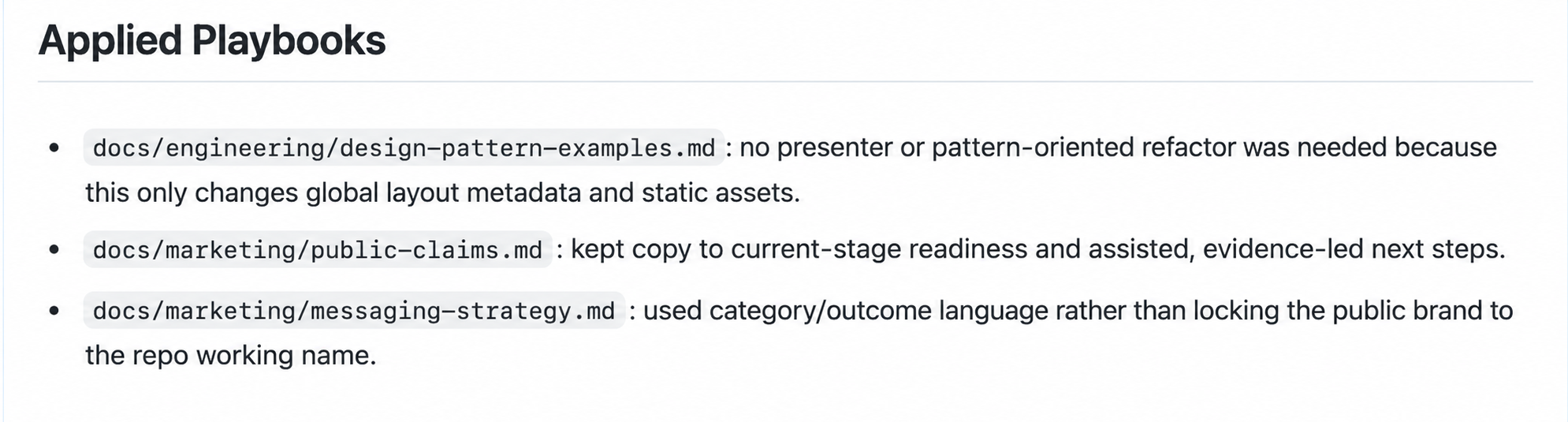
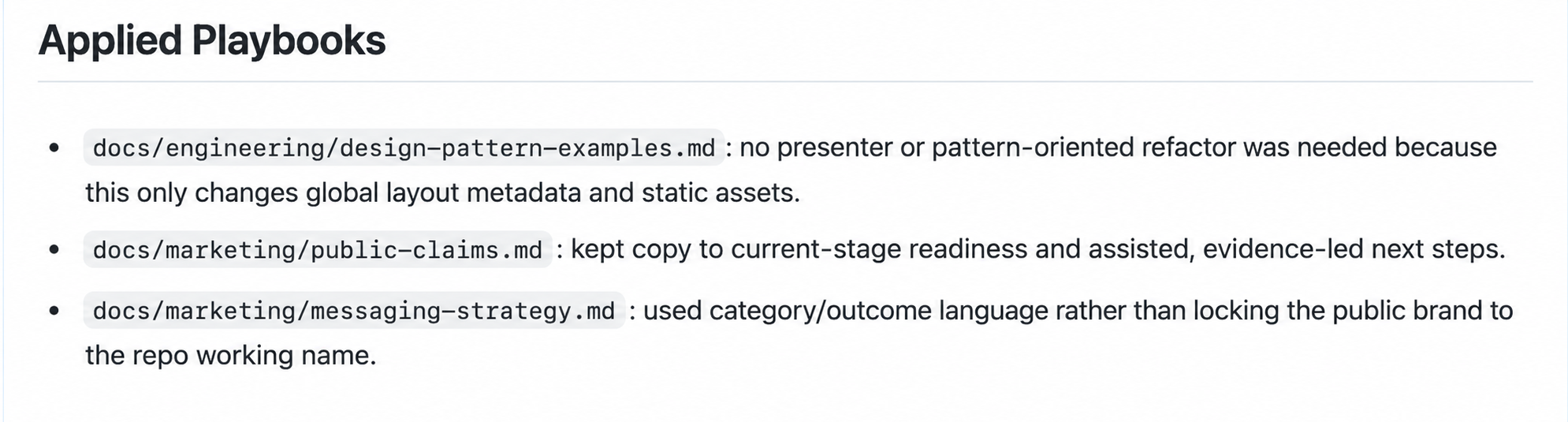
When a PR touches marketing surfaces, the review surface includes which marketing playbooks were applied and what they constrained. You can see, on the PR itself, that docs/marketing/public-claims.md was applied and copy was kept to current-stage readiness. That docs/marketing/messaging-strategy.md was applied and category language was used rather than a brand name that is still evolving.
This is what governance at the boundary looks like. Not a Slack conversation. Not a comment on a doc. A traceable, reviewable record on the artifact that actually changed.
The engineering side was easier to govern first because I had 20 years of SDLC patterns to draw on. Marketing took longer because I had to extract the structural logic from people who had done it well — Hormozi and others — and encode it into constraints that agents and collaborators could actually follow. That work is documented in the agentic marketing department post.
What the factory-for-marketing post established is that the two departments can now hand off cleanly. Marketing proposes bounded changes. Engineering implements within scope. Marketing validates. The PR shows what happened and what rules applied.
Governance is not overhead. It is the thing that makes collaboration between departments legible. Without it, the faster your factory runs, the more quietly it drifts.