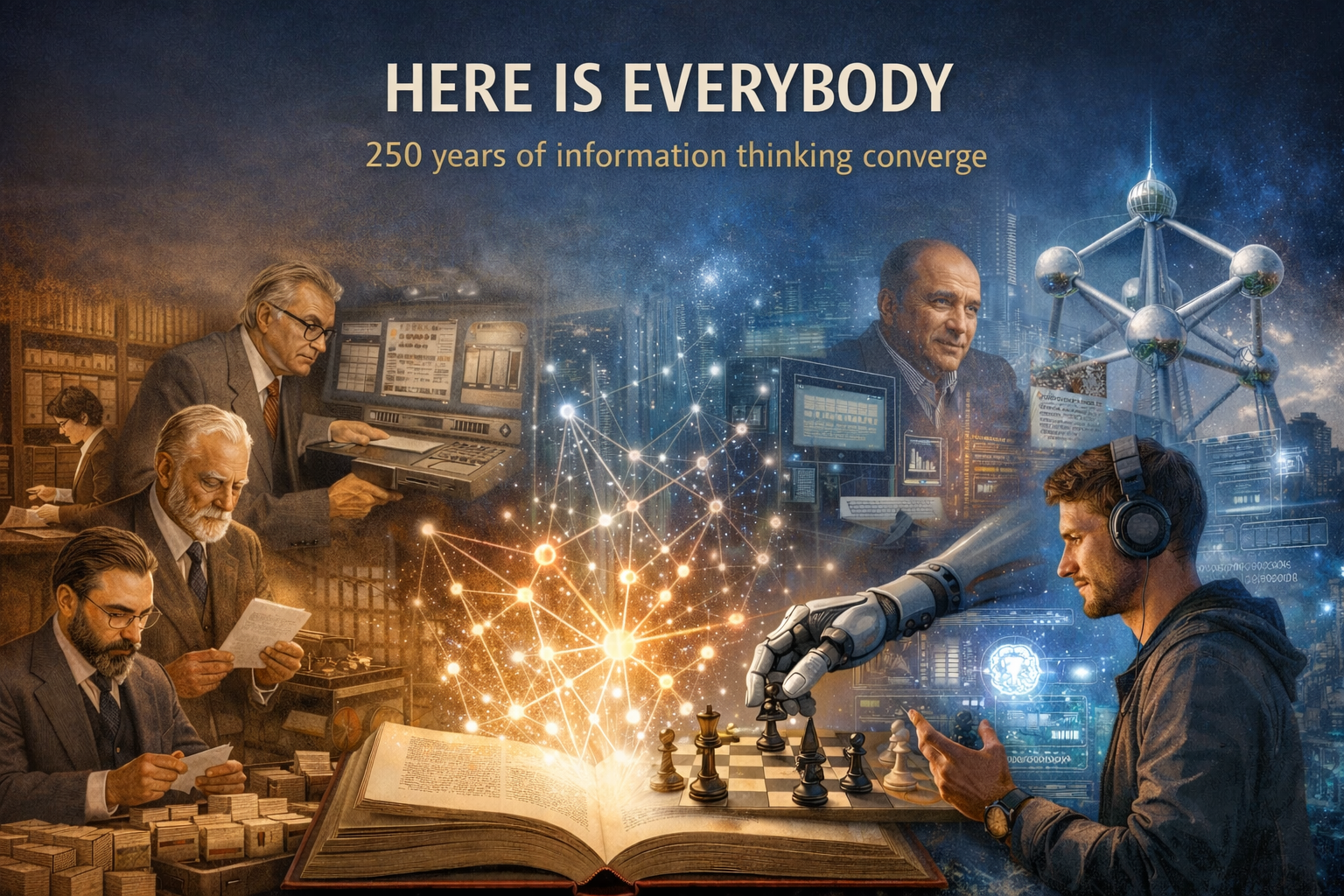
In 2008, Clay Shirky published a book called Here Comes Everybody. His idea was simple, and radical: when the cost of collaboration drops low enough, ordinary people can do what used to require entire organizations.
Five years later, Clive Thompson published Smarter Than You Think. His argument built on Shirky's: human plus machine beats either one alone. He pointed to a freestyle chess tournament in 2005, where two amateurs armed with three ordinary computers defeated both grandmasters and supercomputers. Not the best human. Not the best machine. But the best partnership between them.
Both were making brilliant predictions, but ahead of their time. This piece is the confirmation — but the story starts long before either of them.
It starts in 1895, in Brussels, with a man almost nobody has heard of. I covered this intellectual history in an earlier piece: 250 years of people trying to build systems that think in connections rather than categories. This piece picks up that thread and brings it forward to today — to what is possible right now, in 2026, with multi-agent AI. Not a chatbot, but something fundamentally different.
The man who invented the internet, in 1895
Paul Otlet was a lawyer and bibliographer. Together with Henri La Fontaine — who would win the Nobel Peace Prize in 1913 — he set out to do something almost impossible to grasp in scale: cataloguing all of human knowledge. His Repertoire Bibliographique Universel contained more than fifteen million index cards. Back then, you could send him a letter with a question, and his team would send back the relevant copies. A search engine, a hundred years before Google.
But Otlet was after something deeper: how knowledge actually works, not just how to store it.
His Universal Decimal Classification broke with the Dewey system, the method libraries use to sort books into categories. Where Dewey gave every subject one fixed place in a hierarchy, Otlet built a system that could express relationships between subjects. A book about the psychology of architecture didn't belong on one shelf — it connected psychology, architecture, and cultural studies simultaneously. He called it the principle monographique: breaking documents into components that could be recombined. Wikilinks, but in 1934.
In 1935, he described a "reseau mondial" — a worldwide network. The paper version of what we now call Google. He designed the Mondotheque, a personal workstation for the home, connected to that network. He described the Universal Book as something that would become "an annex of the brain, a mechanism outside the mind but so close to it that it would truly be an extra organ."
When the Germans invaded Belgium in 1940, they decided to use the space the Mundaneum occupied for an exhibition of Third Reich art. In a last desperate act, Otlet tried to personally convince the Nazi inspectors to spare the work. They were unmoved. Soldiers destroyed tons of carefully indexed material — the heart of his collection. Weeks earlier, Otlet had sent a telegram to President Roosevelt offering to transfer the entire collection to America as the core of a new world institute for peace. Roosevelt never replied. Otlet died in 1944, four months after the liberation of Paris. His work disappeared before it ever had a chance. In destroying it, they eliminated the only system that could have put their own plundered knowledge to use.
What also disappeared was the work of Léonie La Fontaine, Henri's sister. She had contributed catalogue entries for the Repertoire Bibliographique Universel since 1893. She set up an information bureau for women from her own home, gathered documentation on women's rights and the peace movement, and built the world's first feminist documentation department within the Mundaneum. The Mundaneum now recognizes her as co-founder, but her name appears in none of the standard histories of the internet's origins. She died in 1949, the year women in Belgium finally won the right to vote.
Ten years later, Vannevar Bush arrived at the same idea, independently, in The Atlantic. He called it the Memex: a desk where users could build "associative trails" between documents. His central insight:
"Selection by association, rather than by indexing, may yet be mechanized."
I found no evidence that Bush knew Otlet's work, and several historians have looked specifically. There was a potential link: Watson Davis, an American pioneer in information science who knew both Bush and Otlet personally. But no source records him passing Otlet's work to Bush, and Bush never references Otlet. Two people, independently, decades apart and an ocean between them — and yet they reached the same conclusion. Which makes it all the more compelling: the idea is so fundamentally right that it presents itself inevitably to anyone who thinks it through. Something I can confirm after three years of working with bidirectional links.
Ted Nelson gave the idea its name in 1965: intertwingularity. Everything is deeply interwoven. Knowledge resists being chopped into neat categories. Of the web that was eventually built, he later said: "The World Wide Web is precisely what we were trying to PREVENT." He was one of the two inventors of hypertext.
Why hierarchy kept winning
Otlet, Bush and Nelson arrived at the same conclusion independently. And yet, thinking in knowledge networks kept losing to hierarchical thinking — a pattern still visible in how modern organizations operate, as if we never left the industrial age.
Around 1900, the Library Bureau — an American company producing office furniture and filing systems — introduced the vertical filing cabinet. Every document got one place in one folder. Craig Robertson describes in The Filing Cabinethow this piece of furniture changed the very concept of information: it became something you could isolate, extract, strip from its context.
In 1981, David Canfield Smith, designing the Xerox Star interface, looked around his office and made an icon of everything he saw. The first folder icon in computing history was modelled on the manila folder — the beige cardboard files sitting in every office. Apple adopted it in 1984 with the Macintosh. Microsoft followed in 1985 with Windows. In 1989, Tim Berners-Lee at CERN chose one-way links, deliberately, because Nelson's bidirectional links would have required a central database that would have kept the web from growing.
Hierarchy is easier to build, easier to control, and easier for institutions to manage. Whoever defines the categories defines what exists. That's not a technical choice — it's a power structure. And for those in power, it creates the illusion of control. For the rest of us, it creates a deeper problem: our minds don't think in hierarchies. They think in connections. That's how our brains actually work.
Your brain works differently from your systems
You probably work with folders. Your email client has a folder structure. Your files live in a hierarchy of drives and subfolders — and every time something belongs in two places at once, you're stuck. Not because you're badly organized, but because the system forces you to choose where something lives, while your brain links it to several contexts at once.
Your brain doesn't make a copy of a memory for every category it fits. It makes connections.
Georges-Louis Leclerc de Buffon saw this in 1749. He looked at the same nature as Carl Linnaeus and saw something different: nature shouldn't be divided into boxes, but understood through relationships. "Nature knows only individuals and cannot be placed in logical categories." He simply lacked the technology to make it work.
Alexander von Humboldt did half a century later what Buffon could not: he put it into practice. For five years he traveled through South America, weaving together climate data, altitude, geology, botany and human culture into a single coherent picture. His Naturgemälde of 1807 was not a map of species but a map of relationships — deliberately without disciplines or boxes. He called it the unity of nature. The method was right. But he too lacked the means to scale it beyond what one person could observe in a lifetime.
The recurring pattern across 250 years of thinking about information is that the ideas were right, but the means were missing. Until now.
A Sunday under an almond tree
On Cyprus, under an almond tree, it started with a simple question. A friend had mentioned something about cyanide in almond kernels and cancer. Plausible, but unproven. I had the time, so I went deep — with multiple AI agents running in Claude Code simultaneously.
By the end of that Sunday, I had crossed three scientific domains: cell biology, clinical oncology and pharmacokinetics. A connection emerged that, as far as I could find, had never been written down before. It seemed that for fifty years, everyone had been looking at the wrong molecule. The result was an ORCID — a unique researcher ID for anyone who publishes — a publication on Zenodo, CERN's open science archive, and an email to researchers in Japan, as I described in this blog post.
I'm not a scientist, and I never wanted to be. But I am a technology philosopher with a laptop, powerful AI to help answer questions, cross-check and fact-check, and a relentless appetite for curiosity.
A few weeks later I fell into the world of genealogy and stumbled on a strange family name somewhere in a distant bloodline: Mundrichts. Something clicked. What followed was a week of Ripuarian-Frankish genealogy, onomastics, prosopography and diplomatics — disciplines entirely unknown to me a week earlier. I followed a hypothetical thread from a Frankish prince in 445 to Charlemagne. I used a scanner that systematically mapped the accessibility of every online archive. And because the output had grown beyond what my own head could process, I created a virtual team of 13 AI reasoning agents, each with its own thinking style and logic.
All of it alone, without budget or organization. With hard, verifiable results in a matter of hours.
The sociologist who saw it coming
Ronald Burt researched the origins of creativity in networks. His answer: not from the best-connected nodes, but from people who bridge gaps between clusters that don't talk to each other. He called it structural holes in networks and put it this way:
"Creativity is an import-export business."
That's exactly what happened on that Sunday. A pattern from cell biology, abstracted, exported to pharmacokinetics. Database knowledge from computer science, exported to medieval studies. Depth comes at the cost of breadth. That's not a deliberate choice — it's just how specialization works.
Shirky called this the Shirky Principle: institutions tend to preserve the problem they were designed to solve. The archivist protects the archive. The oncologist protects the treatment protocol. From the inside, the blind spot is almost impossible to see.
An outsider has no stake in that. An outsider with AI now also has the cognitive means to act on it.
David Epstein described in Range: Why Generalists Triumph in a Specialized World how generalists see connections that specialists miss. But Epstein's generalists needed years to learn enough about a new domain. Tracking down the Waterloo payment receipt for my grandmother's great-grandfather took half an hour, while I was talking with my mother about the origins of our family. That is a paradigm shift in what is possible now — not something that might happen someday in the future, but now, and within reach of anyone with a laptop.
The layer of abstraction that changes everything
Last week, Clive Thompson published a major piece in the New York Times about what is happening to programmers: Coding After Coders. He interviewed more than seventy software developers at Google, Amazon, Microsoft and startups. His finding: programmers no longer write code. They describe in plain language what they want, and the AI translates. Boris Cherny, who leads Claude Code at Anthropic, now contributes one hundred percent of his work to the codebase via Claude. Without typing a single line himself. Just like me — I use voice, not a keyboard.
The strongest example in Thompson's piece is Maxime Cuisy, a print shop manager in Paris with a master's thesis on the French graphic novel and no programming experience whatsoever. When his company had a software problem too small to hire a developer for, he built a working app himself in an afternoon. He has no idea how the code works. The skill didn't matter anymore — the outcome did. Cuisy is the Cyprus Sunday, but for programming.
Thompson explains this through the concept of abstraction: each generation of programming languages adds a layer that hides more complexity from you. AI is the final layer. He ends with a sentence that reaches beyond software: "Abstraction may be coming for us all."
This is where my observation parts ways with his — and the gap is significant.
Thompson describes the abstraction of execution within one field: you no longer need to know the coding language to build software. What I'm describing is the abstraction of the boundaries between fields: you no longer need the vocabulary of a field to see its patterns. That is not the same movement, one layer further. It is a fundamentally different movement.
There is also a third element that Thompson underestimates, though Garry Kasparov put it more precisely back in 2005. In that year's freestyle chess tournament, two amateurs with three ordinary computers defeated both grandmasters and supercomputers. Thompson tells that story in Smarter Than You Think, but emphasizes the human-machine combination. Kasparov drew a sharper conclusion: "Weak human + machine + better process was superior to a strong computer alone and, more remarkably, superior to a strong human + machine + inferior process." He called that combination a centaur: half human, half machine.
The third element is the process. Not human plus machine, but human plus machine plus a well-structured process for thinking. Cramton and Stephen knew when to follow the computer and when not to. They had, in Kasparov's words, learned to drive their computer like a Formula 1 driver drives his car.
On Cyprus, that third element was the ontology and the structure of the reasoning process: multiple thinking agents each with their own perspective, a method that determined when a hypothesis held and when it didn't. Without that process, there was only a laptop with a chat window. With it, something took shape that resembled genuine, careful research.
Thompson reaches for the Jevons paradox to explain the growth: when something gets cheaper, we do more of it. That's true for execution. But connected knowledge works differently. When connections increase, every element becomes more valuable. That's not more of the same — that's emergence. That is precisely the point of Niklas Luhmann, not Jevons.
Which means a fool no longer just needs to ask more questions than a thousand wise men can answer. Now he can find the answers as well. Nearly for free, in no time, across fourteen fields at once.
The data network effect
Otlet dreamed in 1935 of an "organe annexe" — an annex of the brain. Bush described ten years later an "enlarged intimate supplement to memory." Nelson put it in 1965 as "everything is deeply intertwingled." Three thinkers on information, across three decades and two continents, but always driven by the same deep desire: a system that thinks with you, that makes connections you no longer have to make yourself, and that grows smarter as it grows.
For the past six months I have been working relentlessly on ThetaOS, what I call an LLS — a Life Lens System. Built in the absence of existing solutions, drawing on what I learned from these thinkers and what recent technology now makes possible. A web of knowledge and information, tightly connected, producing emergent effects that sharpen my insights and dramatically amplify what I can do.
Luhmann called his Zettelkasten his communication partner. He understood that a system of connected units of knowledge produces emergence: the whole becomes more than the sum of its parts. But Luhmann worked with paper, and only with ideas. What is different now: the connections form automatically, as long as the structure is right. You no longer have to do the linking — your ontology does it for you. The AI and the wikilinks do the rest.
I am finally earning compound interest on my information capital. And it reinforces itself, growing smarter, faster and more powerful every week.
Here Is Everybody
Shirky predicted that coordination costs would disappear and Thompson predicted that human plus machine would be stronger than either alone. Neither foresaw that both would happen simultaneously in a single person.
Kasparov saw the centaur on a chessboard. Shirky's everybody was feitelijk a group. What exists now is a centaur operating alone: an individual with AI-augmented cognition crossing domains that previously only specialized teams could access.
Buffon saw it in 1749. Otlet built it in 1895. Bush dreamed of it in 1945. Nelson named it in 1965. They were all right, but the technology wasn't there — while the intellectual tradition had been waiting for a century and a half. We have reached a turning point.
Here Comes Everybody was the prediction. Smarter Than You Think was the mechanism. Here Is Everybody is the proof.
And all you need is curiosity, a free Sunday, and nothing to lose — except a reputation built on status rather than substance.
Martijn Aslander is a technology philosopher, founder of the PKM Summit and the Digitale Fitheid Academie. This piece builds on his blog series about ThetaOS at world.hey.com/martijnaslander.