Not-so-obvious Ops Toolkit — 2/2
On to part 2 of the Not-so-obvious Ops Toolkit. Here I stray a bit further from math, but still engage with some sedimented, must-have tools for your day to day.
How to time deliveries
Andy Grove through his High Output Management book has taught many on fundamentals of management — and popularized concepts as walk-around management or frequent 1:1s with your team members.
The very first chapter, though, offers a very wild breakthrough for the time: intellectual activity should be thought of in the same manner as a factory or production line. Ultimately, all the variance and unpredictability introduced by creativity or the complex politics that are formed in white-collar jobs should be put under the exact same scrutiny as an engineered marvel of a input-output factory machine.
Let that sink in for a moment. All of the buzz about creative work, about complexities of human relations trying to achieve a tough mission, about iterating through sprints, all of it budgeted and timed just as a production line is.
While it may seem obvious to some at this point, it is a concept barely applied today in most tech companies.
The way this is usually done is through a knowledgeable person proxy: how long do you think it'll take to complete this task? And the more senior the person gets, the more they learn to underpromise on this time range.
What Andy Grove offers is a framework. The question one should make itself when they need to estimate the time-to-deliver something is the following: what will be the most time consuming part of my journey ahead? Then, work to find your critical path around this large chunk of time and boom — instant operational seniority on what was a very difficult question just a few minutes ago.
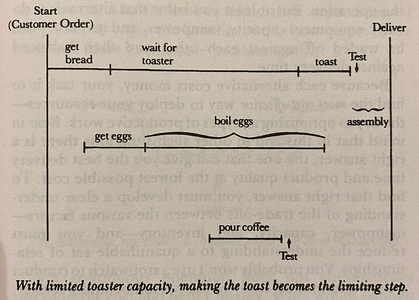
Excerpt figure from Andy Grove's canonical work
How to set measures that increase odds of success
Goals are usually tracked in metrics that reflect directly in P&L or even accounting statements. Revenue, costs or even output efficiency metrics are the ones set in monthly goals, OKRs or weekly follow-ups.
We should definitely keep track on these, but what is often lost is that they're the consequence of organized actions. Thus, these are outputs of inputs made on specific systems, processes, activities.
In any given system, the best way to influence the outcome, is to properly influence the input metrics, in the best way possible given the understanding of the system dynamics.
An example of this is making sure a package arrives in the promised time slot to a customer. Say your sales team has promised a given product will be delivered to your customer doorstep at 10 am. You know for a fact that this customer address is 1 hour away from your distribution center, on average. You also know this customer lives the closest to the warehouse, thus making it a perfect candidate to be the first in a given route. It is clear, then, that the vehicle that will deliver this package needs to leave your warehouse at 9 am, at its latest.
The time the vehicle leaves your warehouse is an input metric, that will increase the odds of success of the expected outcome — adherence to the promised time of delivery. And it's a metric you're able, as a warehouse manager, to influence directly.
Focus on input metrics with proven causal relation or that at least highly correlate with output metrics to increase your odds of success.
How to stay on track
A very common trait among us people is the desire to win. Wether it manifests very explicitly or less so, competitiveness is something found in everyone. One very common way to exploit this will is to create some kind of score — a while back it became even a buzzword, "gamification".
The truth is that a score is not only a great way to incentivize people to compete, but also to give people a precise sense of where they are in the game. Let's take a football score, for instance:

A complex (yet satisfying) score of a Palmeiras vs River Plate math
This is a Palmeiras vs River Plate match from the 2021 Libertadores da América championship (I'm a die-hard Palmeiras fan). This score gives us a lot of information:
- we're almost 70 minutes in a 90 minutes total match (total duration is omitted in the score, but widely known by football audience)
- Palmeiras has scored no goals, while River has scored 2. In this match, River is way ahead — Palmeiras should be worried, specially given the match is being played in their field
- but there's another piece of info, "3–2" just by the side of it. It is a crucial piece of information: the aggregated result from the two matches in this round are still putting Palmeiras ahead of the game. So, while the situation is worrying, Palmeiras is still leading the overall result of the round.
While there's a lot of implicit information in the score, it is telling to anyone familiar with the game. All the players, the head coach, the tactical team, the folks in the bench and the supporters are all aware of where Palmeiras is in the game, and what are the expected actions at this point in time and in this context that it should take in order to secure it's path ahead in the championship.
The score, as simple and nuanced as it may seem, informs not only about the current status of the game, but also of potential choices to be made by different actors in the field.
The exact same concept can and should be applied to our everyday efforts. Having a clear score that shows you how you are in the game, how much are you progressing and how are you delivering against a goal will make wonders to align you and your team to the goal you want to achieve, and make people more independent on their actions — as they will always know what is the delta of effort they need to apply, or the change in tactics they need to make to push the score further for the win.
(I'm happy to say that this score was enough to lead Palmeiras to the semi-finals on what became one of two Libertadores da América titles it conquered in 2021, a historical and likely to be unrepeated fact.)
---
These tools, while not as hard-sciency as the ones from part 1, have given countless teams and organizations a leeway to success in many different contexts. While they're not "operations heavy" subjects, they all rollback to when you're operating something — be it a factory or a software team creating a new piece of innovation.
For me, these are among the most go-to pieces of knowledge in different situations, and along with other well-known techniques, make up for a tool-kit worth the effort of going ever deeper.