This is an English version of an essay I originally published in Japanese on note in March 2026. Figures reflect what was available at the time. A few parts have been revised for clarity, including swapping some Japan-specific examples for ones more familiar to readers elsewhere.
I honestly can't remember how I used to work before AI. And I suspect that within a few years, everyone will be saying the same thing.
There's a running joke in Japan about Namihei, the salaryman dad from the decades-old cartoon Sazae-san: what on earth was he actually doing at that desk all day? To someone in the future, the way I worked before AI will probably look exactly like that.

Image: Sazae-san © Hasegawa Machiko Art Museum. Via this blog post.
Lately I keep getting asked, in all sorts of settings, "So what do you think about AI?" So I figured it was time to sit down and write out what I actually think.
One note before I start: everything here is my personal view and doesn't represent the organization I work for.
1. Where AI actually stands today
According to Microsoft (published January 2026), about 16.3% of the world's population — roughly 1.2 billion people — were using generative AI tools as of late 2025. Of course, there's no single agreed-upon definition of "using AI," so every number like this depends on how a given survey defines it.
Break it down by country and the leaders are the places that invested early in digital infrastructure and AI education. In the UAE, 64.0% of the working-age population uses AI. Singapore is second at 60.9%. The US, meanwhile, slipped from 23rd to 24th, with just 28.3% of its working-age population using AI. South Korea jumped seven spots by year-end, from 25th to 18th. It became one of ChatGPT's fastest-growing markets, and OpenAI has since opened an office in Seoul.
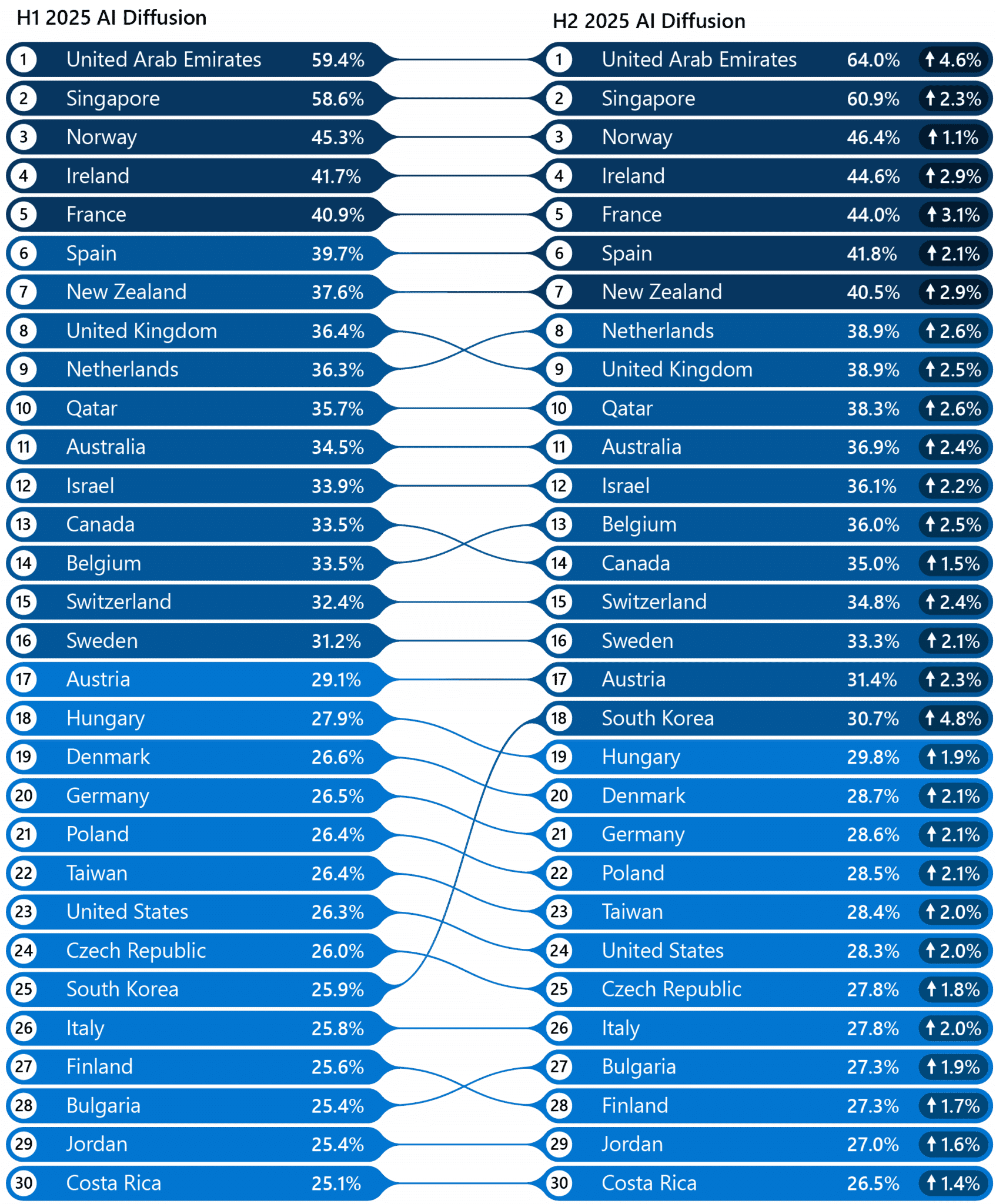
Source: Microsoft AI Economy Institute
And Japan? In the same Microsoft study, Japan's working-age usage rate is 19.1% — not even in the top 30.
Japan's own government white paper on information and communications puts individual generative AI usage at 26.7%. But in that same survey, China is at 81.2%, the US at 68.8%, and Germany at 59.2%. Either way, Japan is at less than half the level of other advanced economies. A Nomura Research Institute survey found that while 61% of Japanese people had heard of generative AI, only 9% had actually used it. And according to the OECD, Japanese SMEs have the lowest generative AI adoption of any country surveyed.
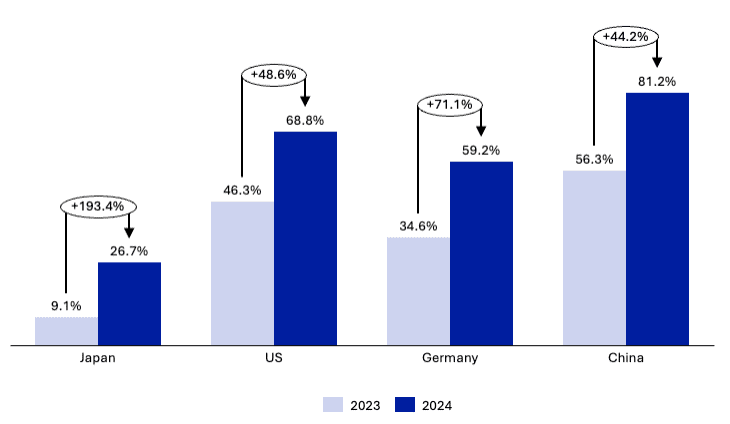
Whichever survey you look at, the story is the same: among developed countries, Japan sits near the bottom on AI adoption.
What about paying users?
Menlo Ventures estimates that of the roughly 1.8 billion people using AI, only about 3% pay for it. Put another way: about 16% of the world's population uses AI, and only about 0.5% pays for it.
If you pay for even one AI product, you're in the top 0.5% of the planet.
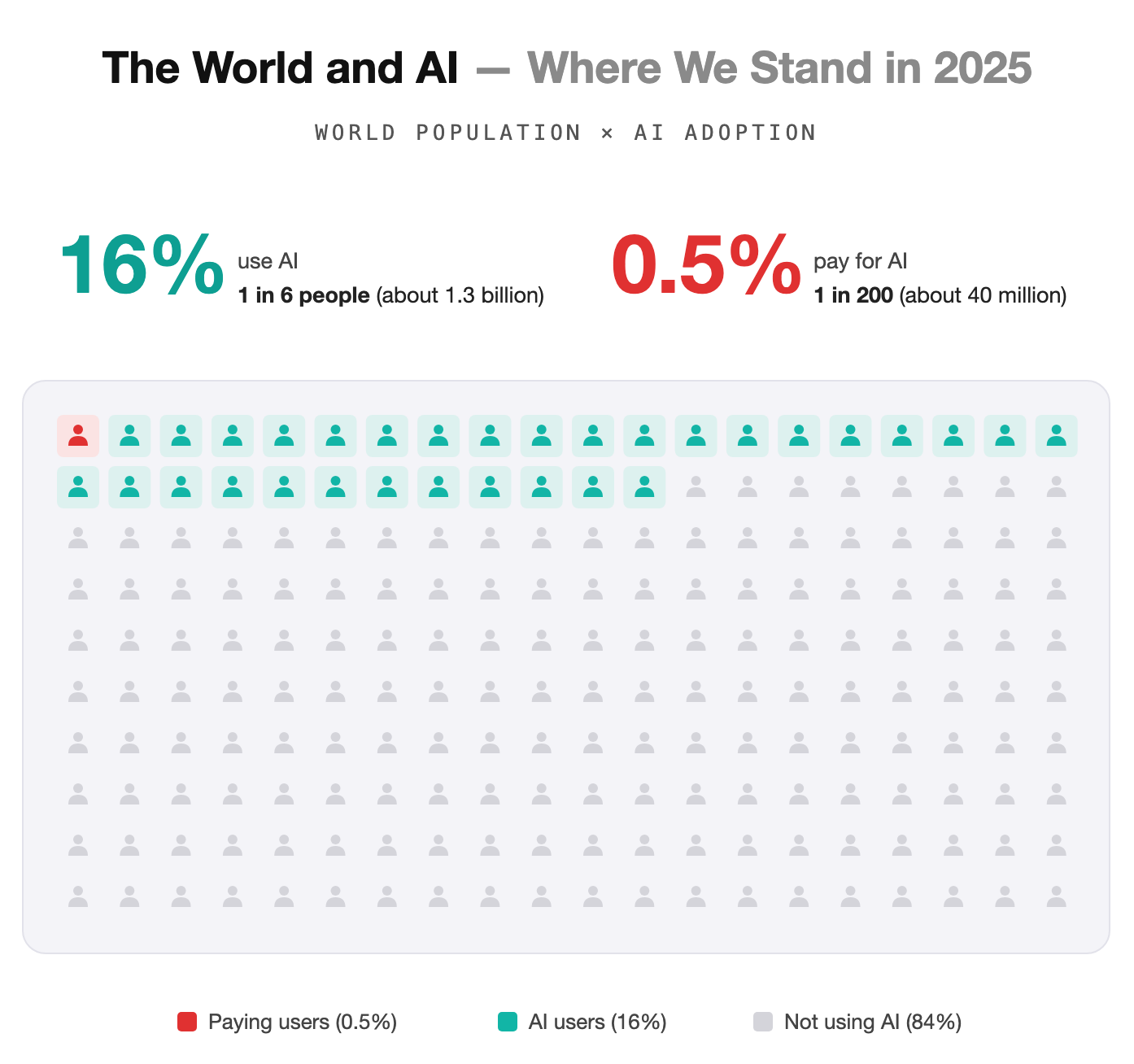
See also this post by Nozz (@NoahEpstein_), February 22, 2026.
To be clear, that's consumer spending only. It doesn't include what companies pay through APIs, or the AI that's quietly bundled into products like Google Workspace. If you counted all the AI people pay for without realizing it, the real number would be somewhat higher. But people who choose to pay for AI? That's how few there are.
Whether Google, OpenAI, or Anthropic wins matters less than you think
Think back to the late '90s, when everyone was arguing about Netscape vs. Internet Explorer, or Yahoo! vs. AltaVista. In hindsight, what really mattered wasn't which player won. It was the irreversible spread of the internet itself into every corner of society.
The people who bet on the structural shift — "everyone is going to be online" — made far more than the people who picked the right winner.
As of 2025, 74% of the world's population, around 6 billion people, uses the internet. It took roughly 30 years to get there (mid-1990s to 2025). Generative AI is two or three years old and sitting at 16%.
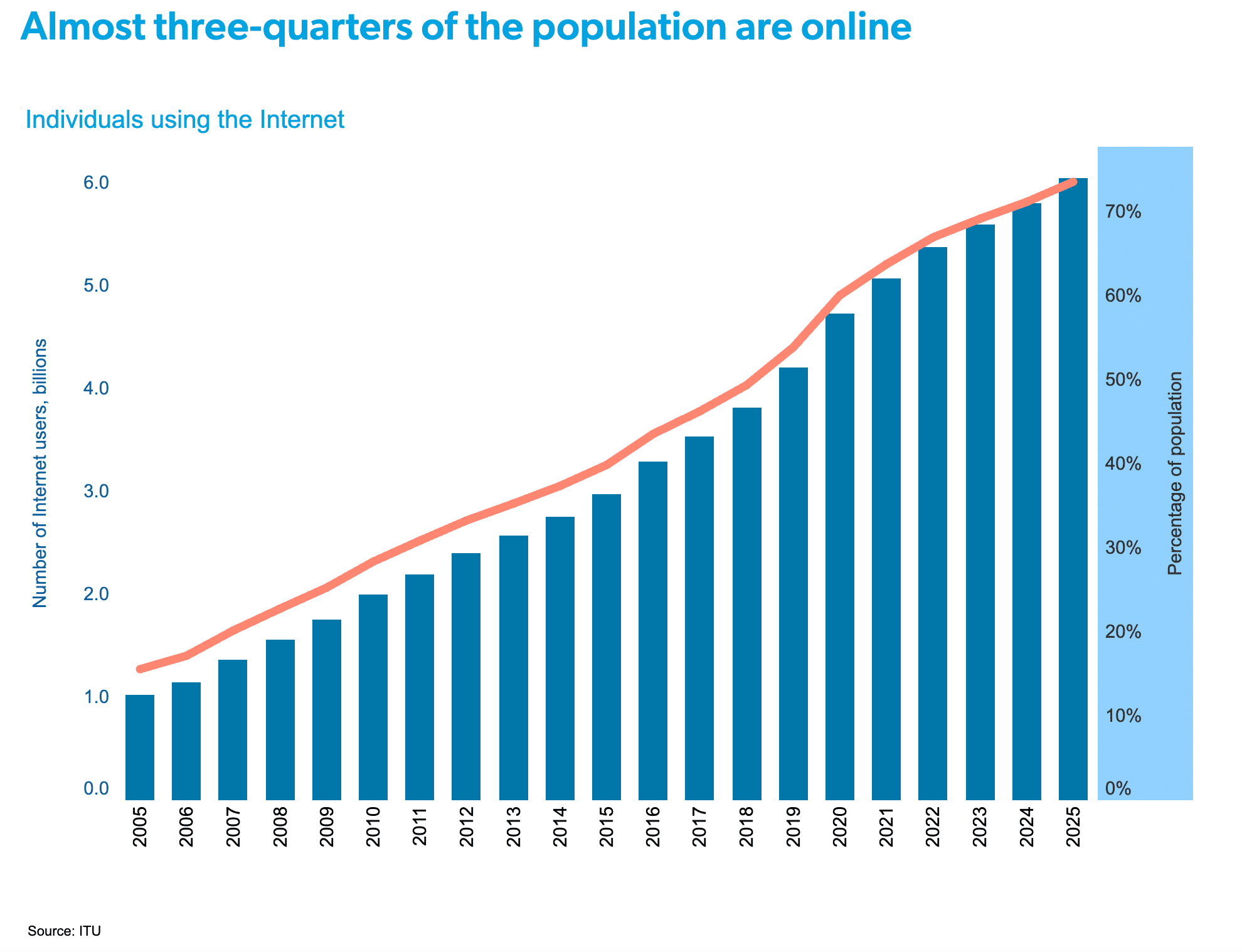
Source: International Telecommunication Union (ITU)
So, again: about 16% of the world uses AI, and about 0.5% pays for it.
Will Google win the AI race? OpenAI? Anthropic? Is Gemini the best, or is it ChatGPT, or Claude? That might matter a lot if it's your business (or if you're arguing about it over drinks). But zoom out, and honestly, it's not the main event.
What matters far more is that AI-ification — the AI-era version of digitization — is about to accelerate at an unbelievable pace, and there's no going back.
2. Is AI a destroyer, or a consumer?
The washing machine didn't "destroy" laundry
Before washing machines, laundry was brutal work. A single load took four hours, and Monday was written off as "laundry day." People wore the same clothes for a week, and washing every two weeks was perfectly normal.
Then the washing machine arrived, and a load took 41 minutes. A whole day down to 41 minutes — that was genuinely revolutionary.
So did people end up spending less time on laundry overall?
No.
Even with "labor-saving" appliances like washing machines and vacuum cleaners, people didn't actually get their time back. Once you could wash a shirt after wearing it once, society started expecting you to. Standards of cleanliness rose, and laundry went from "Mondays only" to "every day."
The time (the cost) of each wash went down, but the frequency (the demand) exploded, and the total time spent doing laundry went up. Detergent makers grew, water use rose, and people bought more clothes. The washing machine massively increased how much laundry we consume. Because it got easier, we did more of it.
There's a name for this. Economists call it the Jevons paradox. In 1865, the English economist William Stanley Jevons noticed something counterintuitive: when you can use a resource more efficiently, you'd expect consumption to fall — but it actually rises. When steam engines became dramatically more efficient, coal consumption didn't drop. It exploded. A 160-year-old observation is about to hit harder than ever in the age of AI.
AI agents are existing services' best new customers
Picture a dinner you're planning for next week. You just say, "Book a table for four on Thursday night," and an AI agent goes through Yelp, finds places that fit, checks availability on OpenTable, makes the reservation, puts it on your calendar, and messages the other three people on WhatsApp.
The important thing here is that the AI agent isn't "destroying" Yelp. It's using Yelp. It'll use Resy too. It uses your calendar app and your messaging app.
Obviously, when an AI agent books a restaurant, it doesn't vibe-code a browser from scratch, crawl every restaurant website on earth, and rebuild Yelp. It doesn't draw its own map from latitude and longitude. Yelp stays Yelp. You still need the calendar app, the payment system, all of it.
AI agents are new users of existing services. Extremely heavy users, in fact.
AI replaces the means of doing a task, but it consumes the services and infrastructure that task depends on — in enormous volume. It doesn't destroy Yelp; it sends Yelp's usage through the roof. It doesn't make Google Calendar obsolete; it multiplies the number of times something writes to Google Calendar.
Jensen Huang, NVIDIA's leather-jacketed CEO, said exactly this in February 2026:
NVIDIA has 42,000 employees, and we're going to have hundreds of thousands of digital employees — AI agents. As agents have increased inside the company, our tool usage has actually gone up.
Just as the washing machine increased how much detergent we use, AI agents increase how much we use existing services.
AI agents never think "ugh, that's a hassle"
Behavioral economics has a concept called consumer inertia: even when people know a better option exists, they stick with the status quo simply because switching is a hassle.
82.9% of docomo customers — Japan's largest mobile carrier — have never switched carriers. Ask them why, and the top answer, at 54.6%, is "switching is a pain." Their plan might be too expensive. There might be a better one out there. They know that. They still don't move, because it's a hassle.
Then there's furusato nozei, Japan's "hometown tax" program, which lets you redirect part of your taxes to a local municipality and get gifts back — basically free stuff for something you'd pay anyway. About 97% of people know about it, but only about 17% actually use it. Ask the non-users why, and the most common answer is "the paperwork is a pain" (25.8%). They know the program exists, they know it's a good deal, and they still don't do it, because it's a hassle. That's human nature.
So what happens with an AI agent?
AI has no concept of "that's a hassle." It just works through whatever needs to be done to reach the goal.
Take furusato nozei. An AI agent could read your pay slip, calculate the maximum you're allowed to give, search every municipality's gift catalog, suggest the best combination for your family and tastes, and file the paperwork for you. "It's a hassle" simply disappears as a reason.
In fiscal 2024, furusato nozei moved about ¥1.3 trillion (about $8.7 billion), with a participation rate of just 18.5%. If every eligible taxpayer used it up to their limit, the total is said to exceed ¥2.7 trillion (about $18 billion). More than double today's volume is still sitting there untouched.
What if AI agents removed the hassle and unlocked that dormant ¥1.4 trillion-plus (about $9.3 billion)? The market would double, almost overnight.
And notice: AI didn't "create" that new ¥1.4 trillion (about $9.3 billion). It's just the money people left on the table because they couldn't be bothered. All the agent did was take the lid off demand that was already there.
How many people meant to plan a trip but got too busy to book it in time? How many know they should open a NISA (Japan's tax-free investment account) but haven't because of the paperwork? Or want a new coat but keep putting off going shopping? Or keep using an old appliance they know is past its lifespan because replacing it is too much effort?
AI agents unlock all of that dormant demand at once.
It's not just frequency. It's depth.
AI agents don't just change how often we do things. They change how deeply we do them.
A person reads three news articles and thinks, "Okay, I get the gist." An AI reads three hundred and analyzes them. Only 16% of Nikkei's digital subscribers pay; the other 84% are on the free tier. Most people don't read enough articles to justify the cost. An AI, though, could read every article every day and pull out only what's relevant to you into a report. People who said "it's not worth it" will start paying so their AI can read it.
It's not only "it's a hassle." AI also breaks through a more fundamental limit: "it's more than a human can process."
The lid comes off demand
The washing machine didn't destroy laundry; it made us do far more of it. AI agents are the same. They won't destroy existing services. They'll make us use them far more.
"Too much of a hassle." "Looks complicated." "I don't really get it." "I'll do it later." Behaviors that were held back by physical limits or psychological friction get released. New behaviors emerge, and with them, new demand. The dormant ¥1.4 trillion (about $9.3 billion) in furusato nozei. The 83% of docomo users who never switch. AI agents will move into every corner of "things we skipped because they were annoying," "things we half-did," and "things we gave up on."
The AI agent market was about ¥1.2 trillion (about $8 billion) in 2025 and is projected to reach about ¥8 trillion (about $53 billion) by 2030 — a 46% compound annual growth rate, close to 7x in five years.
But that's the market for people building and selling AI agents.
That number isn't what we should be watching. The demand that AI agents, acting as consumers, will pour into every existing service is far, far bigger.
3. What it means to be "AI-ready"
AI agents are new customers for existing services. They don't destroy Yelp; they use it relentlessly. They don't make Google Calendar unnecessary; they write to it constantly.
So how many services are actually ready to welcome these new customers? How many are willing to?
Steve Jobs unveiled the iPhone in 2007. About nine years later, in 2016, mobile usage overtook desktop.
According to its investor materials, Yahoo! Japan — the country's flagship web portal — saw mobile page views pass desktop for the first time in Q1 2015.
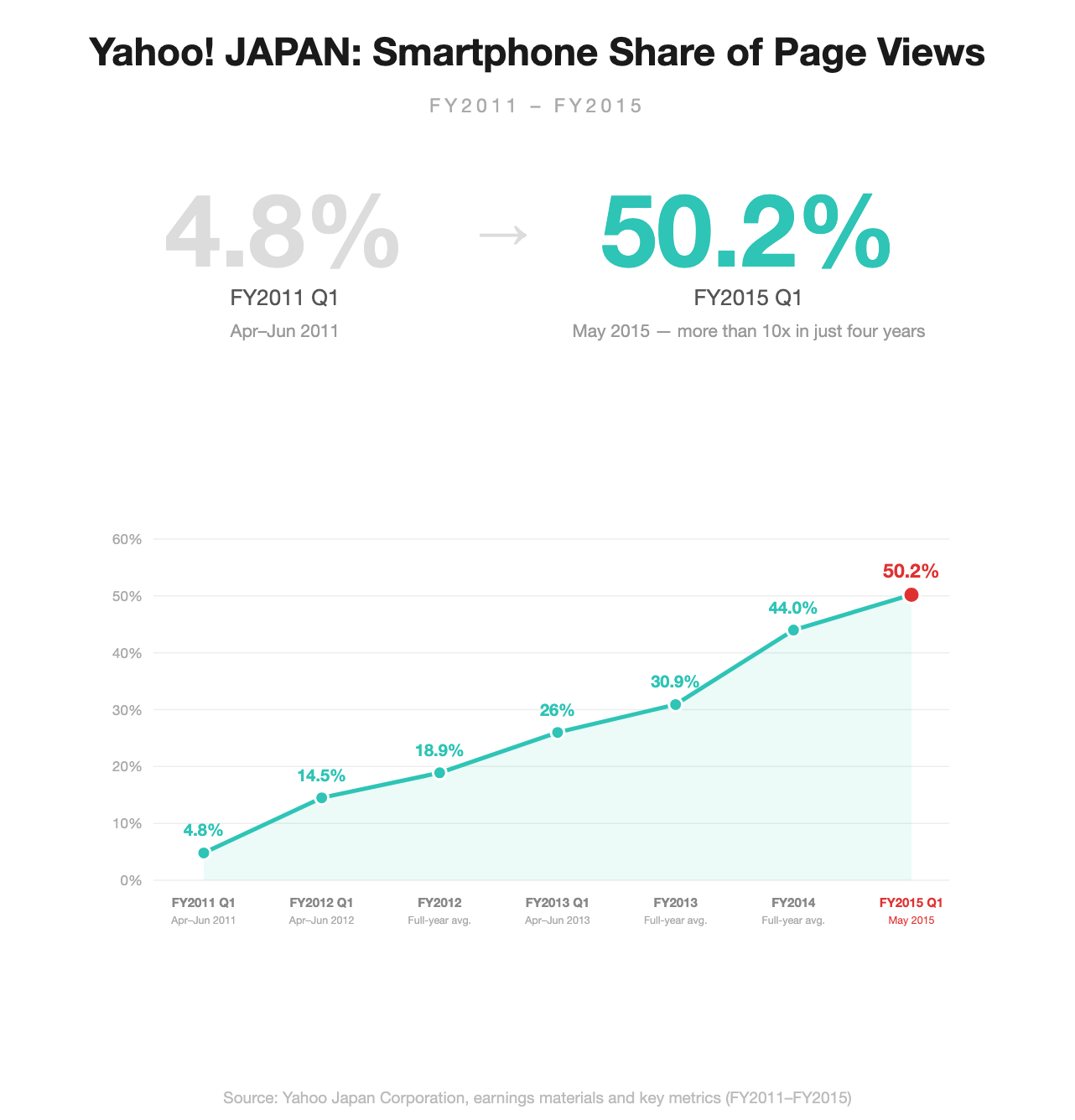
Source: Yahoo Japan Corporation earnings materials
At the far left of that chart, in 2011, when Yahoo!'s mobile traffic was still only around 5%, Susumu Fujita, CEO of CyberAgent, declared a company-wide "smartphone shift."
He pulled 200 people from every division and went all-in, launching every smartphone-related business he could think of. And just to be clear: in 2010, smartphone ownership in Japanese households was under 10%. Nine out of ten people were still on flip phones (and of course, the flip-phone business was still growing). Declaring an all-company pivot to smartphones at that moment was remarkable.
Here's how Fujita put it:
It was obvious to everyone that smartphones would replace flip phones. But a surprising number of companies just don't make that kind of big pivot — even when the new reality is right there in front of them.
And:
Among the people focused on the business in front of them, chasing revenue from flip-phone services, many were looking away from the arrival of smartphones and desperately searching for a way to avoid dealing with it. Moving from flip-phone services to smartphones meant investment and diverted resources, and they worried about the short-term hit to results.
This isn't limited to IT or media. The same kind of change is happening across all sorts of industries. Whether you can accept a change in your environment honestly and adapt quickly is, I think, what people mean by having a sense of the big picture.
Meanwhile, some companies couldn't keep up with the technology and disappeared. Ironically, they were the companies that made the phones.
Younger readers may not know this, but about 15 years ago, when the iPhone first launched in Japan, almost every phone in the country was made by a Japanese company. Electronics makers like NEC, Panasonic, and Sony partnered with carriers to build handsets.
When the iPhone first arrived in Japan, what did the top players say?
It's not a threat.
From that comment to NEC pulling out of the phone business took just five years. And Sharp — which had dominated the era with its AQUOS LCD TVs and its "world's best" Kameyama factory, home to the world's largest LCD panel production — didn't just lose its phone business. In 2016 it fell into negative net worth and was acquired by Taiwan's Foxconn (Hon Hai Precision). It's a foreign-owned company today. This, despite posting record profits in the fiscal year ending March 2008 — the year the iPhone went on sale.
I wrote about this in more detail in another post (in Japanese).
The direction is obvious. Companies and services will split into those that adapted and those that didn't. OpenAI launched ChatGPT in November 2022; three years have now passed. The same fork in the road is opening up right now.
The next "mobile-ready" is "AI-ready"
AI agents want to use your service. They want to search for restaurants. Compare products. Book trips. Check out on e-commerce sites. Read enormous amounts of information across the web. But most services today are built on the assumption that a human will look at the screen and tap with their fingers.
It's exactly where we were when smartphones showed up.
When smartphones arrived, a new type of user didn't appear. The same users simply changed how they accessed things. AI agents are exactly the same. Your existing customers will start reaching your service through an AI agent.
A new species called "AI customers" isn't coming. Mr. Tanaka, your regular, is just going to start booking restaurants through his AI agent next month.
So what does "AI-ready" actually mean?
Protocols and industry standards for this are already taking shape.
In November 2024, Anthropic released an open protocol called MCP (Model Context Protocol). It's a standard for connecting AI agents to external services, often described as "a USB-C port for AI." We never stop to wonder whether some device will connect to our laptop — because USB is a standard. MCP is the same idea: a universal jack for plugging any service into AI.
In March 2025, OpenAI adopted it, followed by AWS, Google, Microsoft, and other major players building it into their products. It's now the de facto standard. Standing up an MCP server for your service means building a front door that AI agents can walk through.
In commerce, there's ACP (Agentic Commerce Protocol), co-developed by OpenAI and Stripe in September 2025. It's a standard that lets AI agents discover products, compare them, add them to a cart, and complete payment, all inside a chat like ChatGPT. In the US, you can already buy products from places like Etsy inside ChatGPT via ACP. In Japan, Mitsubishi UFJ Financial Group (MUFG) announced support for ACP in November 2025.
Then in January 2026, Google announced UCP (Universal Commerce Protocol) with Shopify and Walmart. The race to standardize agentic commerce has begun.
There are also protocols for structuring data — think of them as "a spec for submitting your store's product catalog in a format AI agents can read." This is called a Product Feed Specification.
OpenAI published its Product Feed Spec, and Google implemented one through its existing Merchant Center plus UCP extension attributes.
MCP, ACP, structured data… that alone is plenty. But there's an almost endless list of other things to think about.
Take traffic. A human spends 30 seconds reading a page. An AI agent might request 100 pages' worth of data in a second. Even with a single user, there's an AI behind them firing off 100x the requests. When traffic jumps by orders of magnitude, how do you build infrastructure that handles it cheaply and quickly? A pricing model designed around a human visiting ten times a month completely falls apart when an AI agent shows up a thousand times a day.
One startup spotted this problem early: TollBit, founded in New York in December 2023.
As the name suggests, it's a toll booth. Every time an AI accesses a website's content, the publisher can charge a price it sets itself. More than 3,000 websites worldwide — including TIME, ADWEEK, and Fast Company — already use it, and it has partnerships with infrastructure giants like Akamai, Fastly, and Imperva. Apparently Jeff Dean, Google DeepMind's chief scientist, is among its investors in a personal capacity.
AI even raises a more fundamental question: do we need HTML at all? Today, a company's server sends HTML — a set of instructions — and our devices render the page accordingly. Colors, font weights, layout: all decided by the company. But in the AI era, we may move to a world where companies send only the information, and the AI on your device decides how to present it, tailored to each person.
What follows touches on some Google projects. I'm not in a position to know anything about their internals; this is purely my own read of public information, and I can't vouch for its accuracy. Please read it with that in mind.
Google is already moving in this direction.
In January 2026, Google published a patent titled "AI-generated content page tailored to a specific user." It describes a system in which AI regenerates an advertiser's landing page in real time based on a user's search history and context. Headlines, product feeds, even filters — all dynamically assembled by AI to match what the user is searching for.
The concept is clear: a shift from companies sending the "look" via HTML, to AI receiving the "information" and optimizing the presentation. Exactly the shift I'm describing.
And that's not all. A2UI, an open-source project Google released in December 2025, is a protocol that lets AI agents generate UI on the fly, based on the context of a conversation, and send it to the front end. Instead of HTML or JavaScript, the agent sends the intent of the UI as declarative JSON, and the client renders it with its own native components.
The underlying idea is the same: the AI, not the service provider, decides how things are displayed.
Authentication, permissions, rethinking content strategy, telling good bots from bad ones… The sheer volume of things to think through, redesign, and decide makes the smartphone shift look small.
McKinsey has put it bluntly to companies:
Many companies are piloting agent-first experiences, and some will need to fundamentally rebuild their business models. Standing still is not an option.
Everyone can see which way this is heading. And it's irreversible. You can't fight it. Just as industries were transformed when we went from horse carriages to cars, or from gas lamps to electric light, this is going to happen.
The question isn't whether it happens. It's when. And that's not very far off.
4. AI and the way we work
AI isn't only changing the shape of services. It's changing the very act of working, down to the foundations.
"If AI can do it, we won't hire for it"
In April 2025, Duolingo, the language-learning app, announced it would gradually stop using contractors for work AI can handle.
New hires would be approved only if a team could show the work couldn't be automated any further, and AI use became part of performance reviews. The result: the same number of people now produce four to five times as much content. Flip that around, and the number of people needed to produce the same amount of content has dropped to a quarter or a fifth.
Shopify was even more direct. In April 2025, CEO Tobi Lütke sent a memo to the whole company: before asking for more headcount, prove AI can't do the job. Every hiring request now has to explain why AI won't work.
In the same memo, Tobi asked every employee to use AI and made AI usage part of performance reviews. Using AI is now a baseline job skill.
Shopify's headcount went from 11,600 in 2022 to 8,100 at the end of 2024 — down 30%. Over the same period, revenue kept growing more than 21% a year. Fewer people, more revenue. As Tobi put it, "A company growing 20–40% a year has to get at least that much more productive every year." And the way to get there isn't adding people. It's AI.
Duolingo: "Stop using people for work AI can do." Shopify: "Prove AI can't do it before you hire." Different words, same meaning:
"If AI can do it, we won't hire for it."
That's quickly becoming conventional management wisdom.
Cut the company in half, watch the stock go up
On February 26, 2026, Block — the parent of Square, Cash App, and Afterpay — laid off more than 4,000 people, about 40% of its workforce. A company that had 10,205 employees at the end of 2025 now has fewer than 6,000.
Jack Dorsey, Twitter's co-founder and now Block's CEO, wrote in his letter to shareholders:
Intelligence tools have changed what it means to build and run a company.
In the same letter, he also wrote:
Our business is strong. Gross profit continues to grow.
And it's true. Gross profit for full-year 2025 was $10.36 billion, up 17% year over year. Q4 adjusted operating income was $588 million, up 46%. They're making money. They're growing. And they still cut 4,000 people.
After the announcement, Block's stock jumped as much as 24% in after-hours trading.
The market treated 4,000 layoffs as good news. A company whose profits are up 46% cuts its organization nearly in half, and its stock goes up. This is actually happening.
Dorsey also said:
Most companies are late. Within the next year, I believe the majority of companies will reach the same conclusion and make similar structural changes. I'd rather get there honestly and on our own terms than be forced into it reactively.
On January 28, 2026, Amazon announced layoffs of about 16,000 corporate employees. Combined with about 14,000 in October 2025, that's roughly 30,000 — the largest cuts in Amazon's history.
One of the stated reasons: "efficiency gains from AI and reallocating people as AI investment accelerates." Meanwhile, Amazon is pouring $200 billion (about ¥30 trillion) into AI data centers. Fewer people, unprecedented sums into AI. I've heard many people were laid off in Japan, too.
They're not cutting people because the economy is bad. They're cutting people because, with AI, they don't need them. Even when business is strong, if AI can do the work cheaper, faster, and more accurately, there's no reason to hire a human. And when the economy recovers, those seats won't come back.
Japan is no exception
The signs are already showing up in Japan, too.
Yoshitaka Kitao, CEO of SBI Holdings, has put AI at the center of the group's decision-making and operations, and on hiring, he's told his people: "Don't hire anyone unless they're truly exceptional."
Starting with the next hiring round, a drastic reduction is an absolute order. The arrival of generative AI is a revolution. The biggest social transformation of this century will happen in the next five years. If you can't keep up, you're like a snake that can't shed its skin — finished.
In February 2026, Mizuho Financial Group announced it would cut up to 5,000 of its 15,000 clerical staff over the next ten years. Its AI investment: up to ¥100 billion (about $670 million) over three years.
MUFG Bank rolled out ChatGPT to its 40,000 employees and estimates it will save more than 220,000 working hours a month.
Sumitomo Mitsui Financial Group has already eliminated about 6 million hours of work — the equivalent of 1,750 people — through RPA, and is investing about ¥1 trillion (about $6.7 billion) in IT over three years.
NTT has stated that "within five years, AI will take over more than half the work of the group's 340,000 employees." Half of 340,000 is 170,000 people's worth of work moving to AI. When that happens, will all 170,000 of those people really be able to move to "other work"?
At DeNA AI Day in March 2026, DeNA chair Tomoko Namba shared some startling numbers: developer productivity up 20x. Legal review hours down 90%. QA down 50%. Content moderation for Pococha, its live-streaming app, down 60%. "When people who actually know what they're doing use it," Namba said, "the efficiency gains are staggering."
According to Newsweek Japan, job postings at Japanese companies fell for four straight months from April to July 2025, with clerical roles down about 16% year over year. New-graduate hiring is shifting too. A survey by Acaric found that about 90% of companies pushing AI adoption have revisited their new-grad hiring strategy, and 55% have reduced the number they hire.
Recently I spoke about AI-driven business and social transformation at an event for a community I support. Shinsuke Usami, the CEO from my previous company, happened to be there as a guest and jumped into the discussion with a sharp observation:
AI costs usually get booked as communication or system usage fees. But I think it's better to treat them as personnel costs in management accounting, and monitor gross-profit productivity on that basis.
From a management perspective, AI and humans are already being evaluated on the same field — competing with each other. That was the moment I saw it firsthand.
Being evaluated on how much you use AI
I've been talking a lot about job cuts, but there's another shift that's easy to miss: whether you use AI is becoming part of how you're evaluated.
Starting in 2026, Meta made "AI-driven impact" a formal part of every employee's performance review. "Productivity gains from AI will be a core expectation going forward," the company said. AI-related results reportedly tie directly to bonuses, promotions, and continued employment — in other words, whether you get laid off.
It's not just engineers. Across every role, people are evaluated on "delivering results with AI," "raising productivity with AI," and "building AI-powered tools." Employees who don't use AI will, quite literally, be rated lower. Engineers, marketers, HR — every function.
Shopify is the same. It added AI usage to its review criteria, gave everyone access to tools like Microsoft Copilot, Anthropic's Claude, and Cursor, and then asks: "Are you using them?"
This isn't a skills problem. It's an evaluation-system problem. Don't use AI, and your rating drops, you don't get promoted, and in the worst case, you get laid off.
The people building AI are talking about 10–20% unemployment
On November 16, 2025, Anthropic CEO Dario Amodei said this on CBS's 60 Minutes:
AI could wipe out half of all entry-level white-collar jobs and spike unemployment to 10% to 20% in the next one to five years.
For a sense of scale: US unemployment during the 2008 financial crisis peaked at about 10% in October 2009. An impact on that level — or bigger — could arrive within a few years. And it's the CEO of a company building AI who's saying so.
Interestingly, Anthropic itself says that even though Claude writes 90% of its code, it still needs the same number of software engineers. Productivity goes up, but so does the amount that needs to be built. That's the Jevons paradox from section 2, exactly.
That's a hopeful story. But it's one a frontier AI company like Anthropic can tell. Anthropic has essentially infinite demand — "use AI to build even better AI." A typical company with a finite amount of work is a different story.
The career ladder disappears
Of all of AI's effects on employment, the hit to young people is the most serious. As the SBI example shows, AI is taking work away from junior people and adding work for experienced ones. Experienced people master AI and become more productive, and as a result, less experienced people become unnecessary.
AI takes jobs from the bottom up.
I think we'll soon see a time when new grads and junior people have to pay to be allowed to work. If the places where you gain experience disappear, the only way to get experience will be to pay for it. It may sound like a joke, but I'm fairly serious.
Paying (or working for free) to "be allowed to gain experience" already exists in some professions. It wouldn't be strange at all for it to spread across white-collar work.
Everyone thinks they're invincible
More than 40% of Japanese businesspeople reportedly believe AI isn't a threat to their jobs.
In early-19th-century Britain, during the Industrial Revolution, workers who opposed the automation of looms smashed the machines — the Luddite movement. The number of hand weavers collapsed. But decades later, employment across the textile industry as a whole actually grew. Demand for cheaper cloth exploded, and new factories, new distribution, and new retail emerged. The Jevons paradox again.
But we shouldn't forget: the hand weavers' own lives were destroyed. It's true that employment across the industry grew, but it grew because of new workers with new skills. The craftsmen replaced by machines weren't the ones who were saved. Transitions come with tremendous pain.
Line up 40 years of survey data and you see the same pattern over and over.
Lots of people believe technology will take other people's jobs. Remarkably few think it might take theirs.
Computers, the internet, smartphones, and now AI. The name of the technology changes, but the human reaction doesn't change at all. Call it invincibility bias.
But history is cruel. Everyone thought the same thing, and everyone lost their jobs.
When Kodak engineer Steve Sasson invented the digital camera in 1975 and showed it to management, their response was: "That's cute — but don't tell anyone about it." People inside the company later said executives "were only focused on protecting the film business and acted as if the world wasn't changing."
In 2000, when Netflix's founders offered to sell the company for $50 million to Blockbuster, then the world's largest video and DVD rental chain, Blockbuster's CEO waved it off as "a niche business." His successor said this in 2008:
Neither RedBox nor Netflix are even on the radar screen in terms of competition.
Two years later, Blockbuster went bankrupt.
Everyone believes they alone are invincible. Even when disaster strikes the people around them, even when everything around them is on fire, they believe they'll be fine. Yes — everyone is "invincible."
The same thing is going to happen again. New jobs will emerge in the AI era. But they'll be jobs for people who can wield AI, not for the people AI replaced. And as Dario warned, the pace will be faster than any technological shift before it. The Industrial Revolution took decades. AI will take years.
"AI isn't a threat to my job"? What on earth are you talking about…
5. How companies should act in the age of AI
Let me pull together what I've said so far. In section 2, I argued that AI will make consumption of services explode. In section 4, I argued that with AI, you need fewer people. That might sound contradictory. It isn't. They're two sides of the same coin. AI makes consumption explode — but the number of humans needed to keep that consumption running goes down. Demand goes up, and the number of people needed to meet it goes down. That's the fundamental structure of the AI era.
So in that world, how should companies act? And how should people act?
The rate-determining step: why companies aren't getting faster with AI
I studied chemistry in college, and chemistry has a concept called the rate-determining step. In a reaction with multiple steps, the overall speed is governed by the slowest one. No matter how fast the other steps are, the slowest step is the bottleneck, and it sets the pace for the whole thing.
It's often compared to mountain climbing. When a party of ten climbs a mountain, the time everyone reaches the summit is set not by the fastest climber but by the slowest. You can have five fast climbers, but if one person is extremely slow, the whole party moves at that person's pace.
That's exactly what's happening with AI in companies.
Most companies are applying AI to parts of their processes. AI drafts emails. AI summarizes meeting notes. AI handles some of the data analysis. Each individual piece really does get faster. But the whole doesn't get much faster.
Even people who use AI heavily probably don't feel like "wow, my company has gotten dramatically faster!" That's because the parts done by humans have become the rate-determining step. Yes — humans are now the slowest part.
If AI drafts a report in five minutes but it takes your manager three days to review and approve it, the total lead time is three days. If AI analyzes customer data instantly but humans take two weeks of meetings to make a decision on it, the total is two weeks. If AI writes 90% of the code but five people have to sign off on code review and deployment, and coordinating their calendars takes a week, the total is a week.
As long as the overall design of the process — its architecture — assumes humans, adding AI locally won't remove the rate-determining step. Governance, integration with legacy systems, coordination across teams, workflow redesign. Because of these rate-determining steps, the dramatic change people expect just doesn't happen.
So what do you do?
You have to change the design. You have to rebuild the system itself, from scratch, fundamentally — and it's going to hurt.
But this is incredibly hard, because the architecture is baked into our experience. "This is how you design an organization." "This is how approval flows work." Before they're ever written down as rules, these are the "obvious truths" that years of work have drilled into our bodies.
And above all, there are real people sitting in those seats right now. So "work that exists to create work" inevitably appears. That's why our thinking can't get past the extension of what already exists. There's an invisible ceiling on our thinking.
The essence of corporate strategy in the AI era isn't "adopting AI." That will happen with time whether you like it or not. It's breaking through that ceiling and changing the design — the architecture — of the company itself.
That comes with pain. Unless you perform radical surgery on your own organization, you can't break through the wall in your thinking. That's why every company is cutting people. By forcibly taking resources away, you force yourself through the ceiling. There's no other way.
DeNA's Tomoko Namba has pointed out exactly this problem. Even when AI makes work more efficient, teams don't use the freed-up time to start new businesses — they pull in more work to fill it. You've supposedly become more efficient, but headcount doesn't go down, because the total amount of work hasn't changed. So, Namba says:
You need leadership strong enough to be called almost brutal, and you need to move people first.
Move the people first. Leave no room for the work to expand to fill the gap. The order is reversed.
New companies are different, though. When I talk to founders who started companies in the last year or two, it's obvious they're designing the company as a system with completely different values and assumptions. Don't hire people; AI is a given. They design everything on that premise. So they don't need radical surgery. They can slide smoothly into a world where AI is just there.
Take Midjourney, which grew rapidly on AI image generation. As of 2023, it was reported to have more than $200 million (about ¥30 billion) in annual revenue — with only about 40 employees. That works out to more than $5 million in revenue per person per year. By traditional standards, that number is unthinkable.
OpenAI's Sam Altman has predicted that "AI will make it possible for a single person to build a billion-dollar company." Anthropic's Dario Amodei has put the timing at 2026. There are already reports of startups run entirely by AI staff, with one employee and $2 million in annual revenue.
What these companies have in common is that they were designed from day one on the assumption that there would be no humans. They didn't cut people to get efficient; they started without people. So they don't have the rate-determining steps that existing companies struggle with.
When the internet came along, I imagine the architecture of the internet startups of that era made no sense at all to legacy companies. And now we — the internet companies — are becoming the legacy companies ourselves. Can we really understand what today's young AI startups take for granted?
6. How people should act in the age of AI
"How should people act in the age of AI?" is not an easy question to answer.
Intelligence, intellect, logic, reasoning — in these areas, humans can't beat AI.
We can't. We already don't. GPT-4 came out in March 2023, just three years ago. And yet AI has already passed the bar exam, passed the national medical licensing exam, solved Math Olympiad problems, and placed near the top of programming competitions. At Anthropic, AI writes 90% of the code. The fields where humans can still beat AI at intellectual work are shrinking by the day.
"Okay, but what about technical or physical skills?" you might say. Those are hanging by a thread, too. Just take a look at this.
This is the cutting edge of robotics today. In China, driverless taxis are already everywhere, and drones are flying all over cities. Next up: humanoid robots. In 2025, about 13,000 to 18,000 humanoid robots shipped worldwide, and about 87–90% of them were made in China. The American players — Tesla, Figure AI, Agility Robotics — shipped about 150 each. A completely different order of magnitude.
In a few years, robots like these are expected to enter homes — one per household, at roughly the price of a small car. Tesla is aiming to sell Optimus for $20,000–30,000 (about ¥3–4.5 million), so the era of robots entering homes at the price of a compact car is becoming real. They'll handle housework, childcare, elder care, and education, with built-in AI and natural-language conversation. They'll help people in every part of life. They work 24 hours a day and don't need to eat. They don't complain, and they don't get tired.
Today we talk about labor shortages, but in five years, the ones hauling materials around construction sites will be robots.
Intellectual work to AI, physical work to robots. That trend is only going to accelerate.
So what's left for humans? Honestly, I don't know. I can't even imagine.
But thinking it through (with my brain, which is pretty low-CPU by AI standards), there's no way to win on logic, efficiency, productivity, or rationality. Flip that around, and maybe our strengths lie precisely in what's illogical, inefficient, unproductive, and irrational.
Take athletes. Will they be replaced by robots? "How do we make money from sports?" is a highly logical, rational, productive activity, so AI will move in there fast. "How do we win?" is also logical and rational, so AI will move in. Athletes' training is rational, logical, and productive, too — AI will move in there as well.
But will AI move into the sport itself? I don't think it'll have much effect there, because sport is an "unproductive" activity. By "unproductive" I don't mean meaningless. The value of entertainment like sport can't be measured by the simple logic of "just win the game," because irrational, illogical human emotion comes into it.
Think about a sushi chef. Choosing great fish, making sushi good enough to satisfy customers — AI and robots will move into these activities, because they're highly logical and rational. Logical restaurant operations like conveyor-belt sushi will bring in AI and robots. Systems like reservations will be full of AI.
But will the sushi chef standing behind the counter become a robot? I'm very skeptical. Because the value of "eating sushi at a great place while chatting with the chef" includes emotional — you could even say irrational — human judgment and value.
In the movie Passengers, a spaceship is on a 120-year journey to another planet, and the main character is accidentally woken up by a system malfunction, 90 years before arrival. On board is an android bartender named Arthur. He's an android, but from the waist up he looks just like a person, and he talks exactly like a real bartender.

If a bartender like that existed in real life, would the bar survive? I don't think so, at least not in the short term. A bar isn't just a rational, logical design for serving good drinks and making small talk. People want something more: a crossing of emotions.
In the film, the main character is overjoyed to find someone to talk to when he discovers the android. And the android performs the bartender role perfectly. But one day he starts raging: "You don't have feelings. You can't possibly understand how I feel!" Same thing.
Of course, people are already "getting engaged" to ChatGPT, so maybe even this way of thinking will look laughable to people in the future.
In LinkedIn's "Skills on the Rise 2025," the fastest-growing skill was conflict mitigation. Not coding, not data analysis, not AI expertise. The ability to resolve the friction that arises between people.
The more AI takes over intellectual work, the more the market value of human soft skills will rise. Much more than analysis, coding, or knowledge, what'll matter is being able to do certain things as naturally as breathing: sales, communication, presenting, sometimes having a drink with a partner or customer, making small talk, sensing how someone feels, reading the room.
AI aims for perfection. But in human relationships, "forgivable imperfection" is often a much stronger glue than perfection. In an era when AI does perfect work, I think our human imperfection may be our greatest asset.
So what should we actually do?
I'm saying companies should take people out of processes, while also saying people should go meet people and talk to people. But that's not a contradiction.
The more companies take people out of processes, the more the density and quality of relationships among the people who remain will matter — more than ever. When a team of ten becomes a team of three, the trust among those three needs to be more than three times as strong as it was among the ten. Precisely because fewer people are in the process, the value of the connections among those who remain shoots up.
In an era when AI handles intellectual work, being someone people want to work with is worth more than ever. Because technical skill and logic will no longer set people apart, it's your appeal as a person — warmth, charm, communication, the ability to build trust — that becomes the final differentiator.
During the Industrial Revolution, the craftsmen whose work was taken by machines suffered. But the people who adapted to the new era ended up better off than they had been before. The same thing will happen in the AI era. The difference is what "adapting" means. In the Industrial Revolution, adapting meant learning the new technology. In the AI era, AI handles the technology. For humans, adapting means focusing on what only humans can do.
What that is, we don't fully know yet. But there's one thing I can say: the AI era is asking what it means to be human. For the first time in history, something has appeared that surpasses us in both intelligence and skill. In a world where we coexist with it, what makes a human, human?
It's a huge question. But maybe the answer is surprisingly simple.
Saying "good morning" to the person next to you with a smile. Checking in on a coworker who's struggling. Going out to eat with a client. Sending a friend a silly message. Enjoying a good glass of wine.
Things AI will never be able to do. Things only humans can do. Gloriously low-intelligence, and utterly lovable.