Most people think inflation arrives with a bang. A war breaks out. Oil spikes. Petrol prices jump overnight. Headlines scream. Central banks react.
That's not how the dangerous kind works.
The dangerous kind is quiet. It starts upstream, deep in supply chains most people have never heard of, and it travels slowly — six months, a year, sometimes longer — before it shows up on our grocery bill, our electricity tariff, our mortgage rate. By the time we feel it, the decision that caused it was made long ago, by a farmer in Thailand, a shipping insurer in London, or an ammonia plant operator in Qatar.
I want to show you what I understood on how this works.
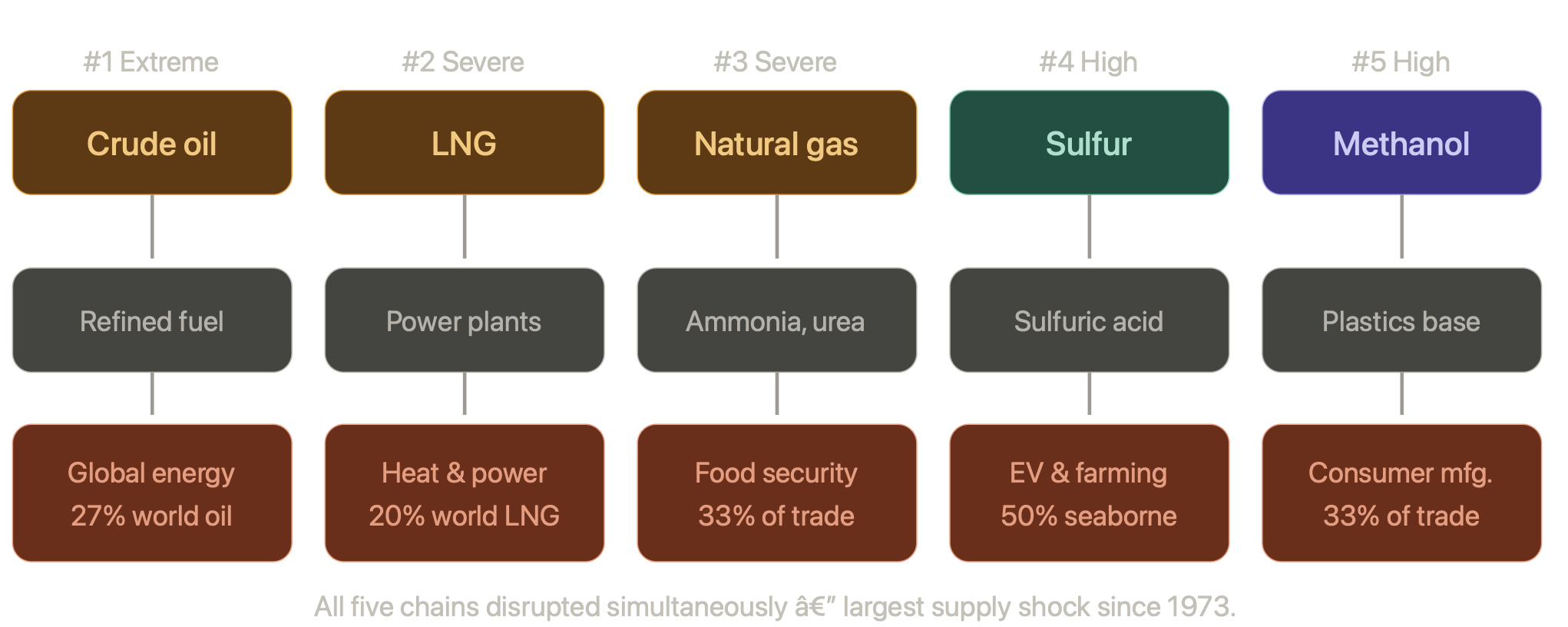
The trigger doesn't have to be visible The Strait of Hormuz has been effectively closed since late February 2026. A 33-kilometre waterway. Most people couldn't place it on a map without help. Yet through it flows 27% of global maritime oil, 20% of global LNG, 33% of internationally traded fertilizers, half of all seaborne sulfur, and a third of global methanol trade.
When that waterway closes, it doesn't just disrupt the commodities we recognise. It disrupts the inputs that make the things we buy, grow the food you eat, and power the grid that keeps our world running.
Five supply chains. Hit simultaneously. Each with a different delay before the damage reaches us.
Chain 1: The one we all see
Crude oil → refined fuel → energy prices. This is the visible inflation. We feel it at the pump. We see it in airline surcharges. We notice it in your electricity bill. Over 10% of global consumption has been disrupted. Strategic reserves are being released to cover the gap — but reserves replace a flow with a stock, and stocks run out. They also have to be rebuilt, which means the pressure doesn't disappear when the strait reopens. It simply changes shape.
LNG → power grids → industrial output. Qatar declared force majeure on all LNG contracts on March 4. Iranian strikes on Ras Laffan on March 18 knocked out 17% of Qatar's LNG production capacity — damage that engineers estimate will take three to five years to fully repair. LNG spot prices in Asia surged over 140%.
Japan, South Korea, Singapore, the Philippines: these economies run on imported gas. There is no fast substitute. Some are restarting coal plants they were supposed to be retiring. Others are imposing four-day government workweeks and mandatory 20% cuts in electricity consumption.
This inflation moves through industrial production costs before it reaches consumers. It takes longer. It is harder to trace. But it gets there.
Chain 3: The one that will hit us in 2027
Natural gas → ammonia → urea → food. This is the silent chain. And it is the one I wanted to understand most clearly, because I read about urea, ammonia and so on, but I'm not an expert. And I love to simplify to get it. Here is what I understood and it's not nice.
Urea is the world's most widely used nitrogen fertilizer. It is made from natural gas. About 33% of globally traded fertilizer transits the Strait of Hormuz. Since late February, prices have risen 50% in some markets and doubled in others. The spring planting window — the narrow band of weeks in which seeds must go into the ground across Southeast Asia, South Asia, and the US Midwest — is closing right now.
Farmers in Thailand (and many other Southeast Asia countries) are doing brutal math: plant without fertilizer and take the yield hit, plant with it and risk bankruptcy, or don't plant at all. Some are choosing the third option. Some are substituting chicken manure for urea. None of these are equivalent choices.
Here is what makes this chain so dangerous: the damage is already done, even if the strait opens tomorrow. A missed planting window cannot be reopened. The 2026 harvest will be smaller. Food prices will rise. Not today. Not next month. In late 2026 and through 2027.
We won't connect the price of rice in your supermarket to a Qatari gas field or a Thai pineapple farm. But the connection is there, and it was made months ago.
Chain 4: The irony at the heart of the green transition
Sulfur → sulfuric acid → EV batteries and phosphate fertilizers. Nearly half of all global seaborne sulfur trade originates in the Gulf. It feeds sulfuric acid production. Sulfuric acid feeds two entirely separate industries through the same upstream input.
The first is EV battery manufacturing. The HPAL process used to refine nickel, cobalt, and copper for battery cathodes is a massive consumer of sulfuric acid. Indonesia — the world's largest nickel producer and a critical node in the global EV supply chain — is already seeing slowdowns.
The second is phosphate fertilizers. Sulfuric acid reacts with phosphate rock to produce the fertilizers that deliver phosphorus — the second most critical macronutrient for plant growth after nitrogen. So the sulfur shortage hits food production through a completely separate chemical pathway from the urea chain.
One shortage. Two victims: the green transition and food security. At the same time. Through the same chokepoint.
If we thought the answer to expensive oil was simply to accelerate the shift to electric vehicles, this chain shows us how the crisis is more systemic than that. We cannot electrify our way out of a supply chain disruption that is hitting the inputs our batteries are made from.
Chain 5: Everything else
Methanol → plastics → consumer manufacturing. A third of global seaborne methanol passes through Hormuz. Methanol is the feedstock for resins, coatings, plastics, and packaging. It is less dramatic than the others, more substitutable at the margin, more spread across many products. But it is real, and it runs through nearly every consumer goods category.
This is the diffuse inflation — the kind that adds two percent here, three percent there, across hundreds of product lines, in ways that no single price index captures cleanly.
Why we don't feel it yet Two reasons. Both structural.
The first is time. Supply chain disruptions travel slowly to consumers. The farmer who didn't plant in April doesn't affect our food price until the autumn harvest fails and winter stocks tighten. The LNG plant damaged in March doesn't raise our electricity bill until the utilities renegotiate contracts in Q3. The methanol shortage doesn't hit our supermarket shelf until the packaging manufacturer passes on costs to the food company, who passes them on to the retailer, who finally passes them on to us. Each handoff takes weeks or months.
The second is distraction. We are living through the most powerful technology bull market in AI, data infrastructure, cloud computing, semiconductors: the numbers are extraordinary, the enthusiasm is genuine, and the markets are reflecting it. It is very hard to worry about urea in Thailand when Nvidia is printing record earnings.
But here is the thing about the AI buildout: it runs on energy. Enormous quantities of it. Data centres, cooling systems, power grids. The technology boom and the energy crisis are not running in parallel. They are converging. A boom that demands ever more energy, in a world where energy supply chains just took their worst hit in fifty years, will eventually feel the friction.
The compounding factor nobody mentions When supply tightens, countries protect themselves. China — the world's largest fertilizer producer — has already begun restricting exports to shield its own agricultural sector. India is prioritizing domestic consumption of refined products. Thailand has imposed export controls on fuel.
The Hormuz closure doesn't just remove supply from the market. It triggers a sequence of defensive moves that remove more supply still.
What happens next Nobody knows the exact scenario. Ceasefire talks continue. The strait has partially reopened, then closed again, in a pattern of uncertainty that is itself a form of disruption — because ships won't move through waters where they might not be insured tomorrow.
What I can say with confidence is that the inflation from the spring 2026 disruption is already manufactured. It is sitting in missed planting windows, in damaged LNG infrastructure, in farmers who chose not to sow, in supply chains reconfigured around longer, more expensive routes. It is moving toward consumers at the speed of harvest cycles, contract renegotiations, and quarterly earnings calls.
It will arrive. Quietly. Without announcing itself.